T-Shirt Design Trends 2026: 8 Evidence-Backed Ideas
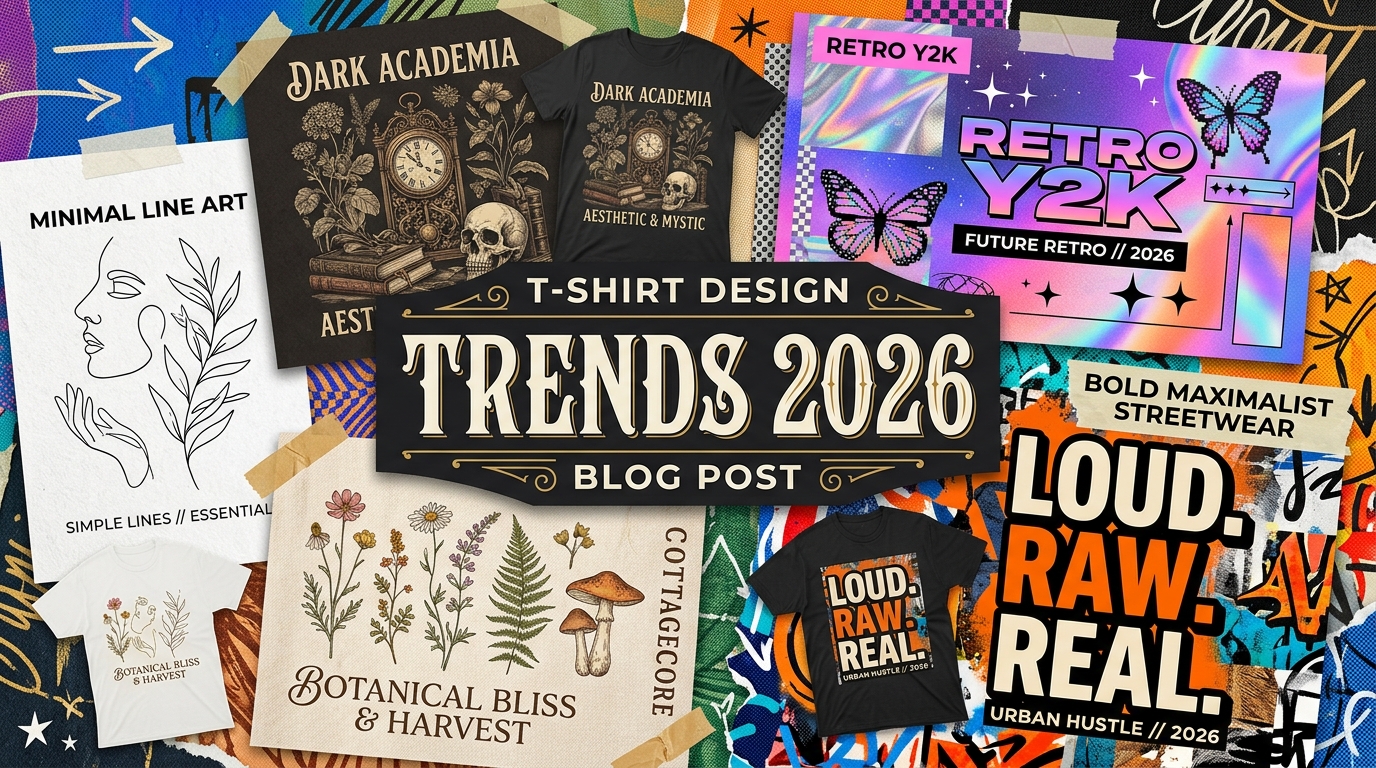
The most useful t-shirt design trends for 2026 are handmade-looking textures, playful whimsy, analog-journal graphics, gallery-style art, botanical motifs, gothic romance, strong colour contrast, and retro typography. None is a guaranteed bestseller. Treat each as a visual ingredient, combine it with a specific buyer or occasion, and validate the combination before building a large collection.
This guide separates evidence from interpretation. Etsy's Spring and Summer 2026 report supplies directional marketplace data. Pinterest Predicts 2026 adds broader visual forecasting. Printify's current t-shirt design ideas reinforce practical themes such as contrast, nostalgia, readable typography, and audience specificity.
Source note: Etsy says its figures cover a subset of signed-in U.S. activity through February 10, 2026 and are directional. A surge in phone-case searches does not prove the same motif will sell on shirts. It is a clue worth testing.
2026 t-shirt trends at a glance
| Direction | Evidence signal | Shirt-specific angle |
|---|---|---|
| Soft stitch | Etsy: embroidered straw-bag searches +20,000% | Faux embroidery, patchwork or visible-mending graphics |
| World of whimsy | Etsy: whimsical jewellery +84%; polka-dot phone cases +835% | Odd animals, dots, playful micro-slogans |
| Dear diary | Etsy: traveller-journal searches doubled; journal charms +395% | Handwritten notes, date stamps, ticket-stub layouts |
| Everyday exhibits | Etsy: gallery prints +80%; abstract art +38% | Curated mini-print or abstract front graphic |
| Botanical bride | Etsy: wildflower wedding signs more than doubled | Garden clubs, wedding crews, birth flowers |
| Gothic romance | Etsy: stained-glass wedding signs +200% | Cathedral florals, lace-like borders, dark botanicals |
| Intentional colour | Printify emphasizes contrast and limited core palettes | Two-to-four-colour systems chosen for the shirt blank |
| Retro type | Printify and Pinterest both foreground nostalgia | Original throwback lettering without copied brands |
1. Soft-stitch graphics
Etsy calls this the “Soft Stitch Era.” Its report shows a 20,000% increase in embroidered straw-bag searches, a 36% increase in crochet-clothing sales, and strong growth for handmade jumpers. Those numbers cover several product categories, but the visual signal is clear: buyers are noticing texture and visible craft.
For a printed shirt, do not fake a product description by calling ink “embroidered.” Borrow the look instead. Use uneven thread paths, patch edges, cross-stitch grids, or a tiny illustrated repair mark. The listing should still state the actual print method.
Prompt starter: “Original t-shirt graphic of a sleepy garden snail built from chunky stitched shapes, visible thread texture, imperfect patch edges, four-colour palette, isolated composition, no garment mockup, no text.”
2. World-of-whimsy motifs
Whimsy is the easiest trend here to misunderstand. It is not a licence to pile random clip art onto a canvas. Etsy's data points to specific playful behaviour: whimsical-jewellery searches rose 84%, polka-dot phone cases rose 835%, and beginner needlepoint kits rose 175%.
On shirts, a single strange idea usually reads better than a crowded collage. Try a frog carrying a baguette, a serious pigeon with a tiny briefcase, or a fruit character paired with one dry line of copy. Keep the silhouette readable at thumbnail size.
Prompt starter: “Playful t-shirt illustration of a small pigeon commuting with a briefcase, slightly awkward expression, irregular polka-dot frame, screen-print texture, three inks, isolated on plain background, no logos.”
3. Analog journal and keepsake layouts
Etsy reports that traveller-journal searches doubled, journal-charm searches rose 395%, and memory-journal searches rose 189%. That is more than a stationery trend. The shared idea is evidence of a life lived offline: dates, handwriting, worn paper, collected fragments.
A shirt can use that language without looking like a scrapbook dump. Build around one memory: a trail date, a family recipe, a city coordinate, or a concert set-list format using original text. Ticket stubs, date stamps, margin notes, and taped-photo borders make useful supporting shapes.
Prompt starter: “T-shirt graphic arranged like one page from a well-used hiking journal, original contour sketch, date stamp, small weather note, torn paper edges, faded forest green and rust inks, no real park logo.”
4. Everyday exhibits and wearable abstract art
Gallery prints rose 80% in Etsy search data, while abstract-art searches rose 38%. A shirt is not a wall, but the same collecting instinct can translate into a compact series of small artworks or one confident abstract composition.
This direction works best when the art has a system. Choose three related shapes, one repeated line weight, and a restrained palette. A random “artsy” image is easy to generate and hard to remember.
Prompt starter: “Wearable abstract t-shirt artwork, three interlocking organic shapes inspired by river stones, cobalt, ochre and cream, visible dry-brush texture, balanced vertical composition, no frame, no text.”
5. Botanical designs with a named recipient
Etsy's Botanical Bride trend includes wildflower-wedding-sign searches that more than doubled and floral-necklace searches up 99%. Botanical imagery is broad, so the design needs a reason to exist. “Flowers on a shirt” is not much of a concept. “The birth flowers of three sisters” is.
Useful buyer angles include gardening clubs, wedding parties, memorial keepsakes, regional wildflowers, and birth-month collections. Check whether a plant has local or cultural meaning before writing the listing.
Prompt starter: “Original t-shirt bouquet combining marigold, aster and sweet pea, labelled only with the months October, September and April, clean engraved line work, warm two-colour ink, isolated, no stock-art layout.”
6. Gothic romance, not generic gothic
The darker trend in Etsy's report is specific: cathedral lace, stained-glass details, Victorian references, and botanical drama. Stained-glass wedding-sign searches rose 200%, while sales of lace wedding accessories rose 63%.
For shirts, that suggests dark florals, window geometry, swans, thorny frames, or restrained serif lettering. Avoid copyrighted book quotes and familiar band imagery. The mood can be recognisable while the composition remains yours.
Prompt starter: “Gothic-romance t-shirt emblem, two original swans beneath a pointed stained-glass arch, thorny wildflowers, black and muted wine ink, fine lines simplified for garment printing, no words.”
7. Intentional colour and hard-working contrast
Printify's 2026 guidance recommends choosing two to four core colours and judging them against the actual shirt blank. That sounds basic because it is basic. It is also where plenty of otherwise good artwork falls apart.
Test the design on light, dark, and heather mockups. Check the smallest text at thumbnail size, then inspect fine lines at the intended print dimensions. Low contrast can work for a quiet premium look, but it should be deliberate rather than an accident.
Prompt starter: “Bold t-shirt illustration of a night cyclist, limited palette of electric blue, signal orange and cream, high contrast for a black shirt, strong central silhouette, no gradients, no brand marks.”
8. Retro typography with original language
Nostalgia appears in both current POD guidance and 2026 visual forecasting. The safe creative move is to borrow structure, not property: chunky letterforms, offset shadows, old print texture, limited palettes, and era-specific spacing. Do not borrow a sports team, soda logo, slogan, or type treatment so closely that buyers could confuse the source.
Write the phrase first. Search it, check relevant trademark databases for your market, and then build the lettering around its meaning. If the copy is weak, chrome effects will not rescue it.
Prompt starter: “Original retro t-shirt lettering for the phrase ‘TAKE THE LONG WAY’, wide 1970s-inspired letter shapes, hand-drawn offset shadow, sun-faded orange and brown, worn ink texture, centred, no existing logo.”
How to validate a t-shirt trend before publishing
- Define the combination: trend + buyer + occasion + product. “Whimsy” is too broad; “whimsical retirement gift for birdwatchers” is testable.
- Check the exact phrase in Etsy Marketplace Insights, Google Trends, marketplace autocomplete, and your own search data.
- Inspect the first page of results for relevance, price range, review recency, and visual sameness. A huge result count alone says little.
- Create a small test with two or three genuinely different treatments. Do not upload 20 near-duplicates.
- Measure impressions, click-through rate, favourites, add-to-carts, and sales. Give seasonal work enough lead time to be indexed before the occasion.
- Expand the winning buyer-and-style pair. Retire ideas that get impressions but no clicks, or clicks but no buying signals.
Use the merch demand-validation workflow to structure the test. If you need artwork, start with the AI t-shirt design generator, then check the final file with the print-ready design guide. For listing copy, adapt the t-shirt product-description examples to the real blank, print method, sizing, and care instructions.
What the 2026 evidence actually says
The evidence supports visual directions, not a universal list of “winning shirts.” Etsy's report is strongest for its own marketplace and geographic subset. Pinterest forecasts culture and search behaviour, not sales. Printify explains design practice from a fulfilment platform's perspective.
That is enough to make better experiments. It is not enough to promise a bestseller. Pick one direction that fits an audience you understand, make an original design, and let your own store data decide what deserves a collection.