Is Print-on-Demand Passive Income? A Realistic 2026 Guide
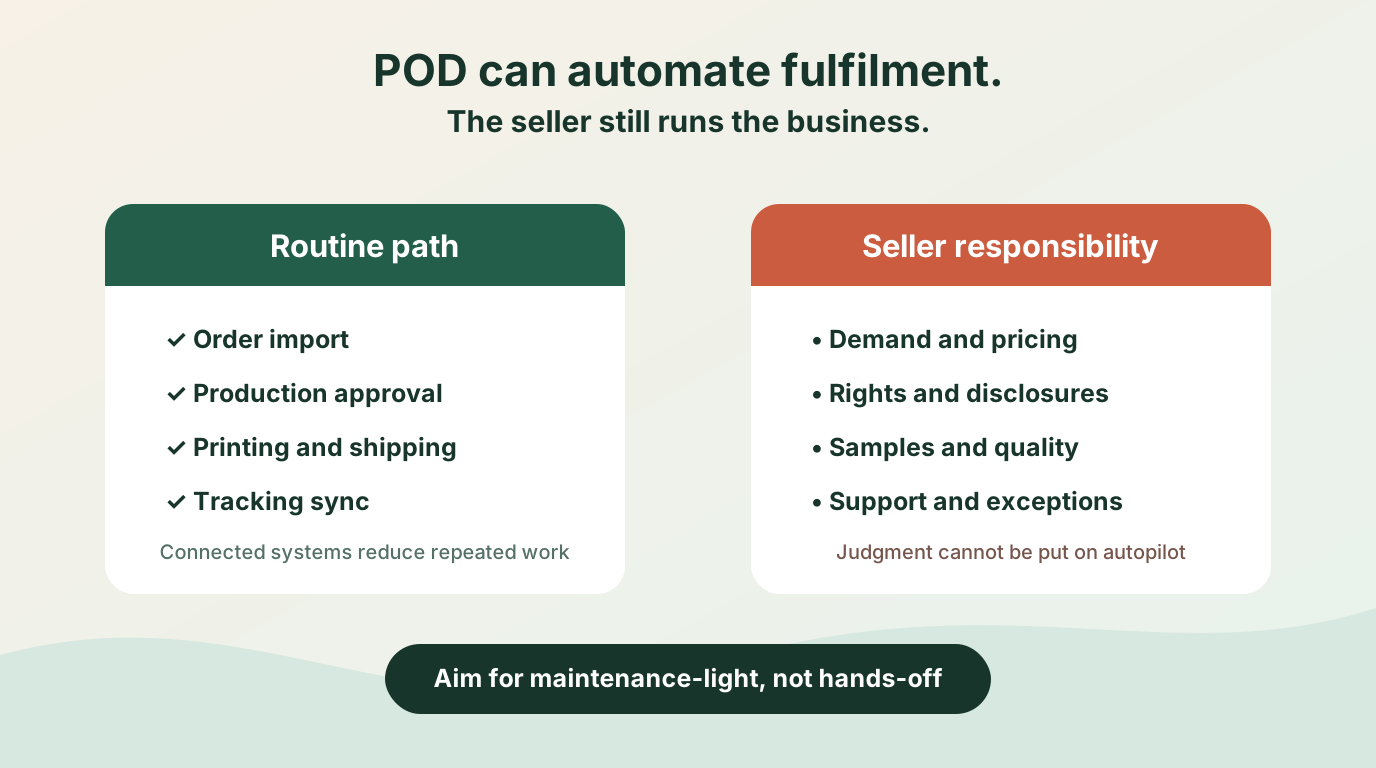
Print-on-demand passive income is not passive at the beginning. A fulfilment integration can send paid orders to a printer, start production, and return tracking without the seller packing a box. It does not choose a viable audience, clear a design for sale, inspect a sample, fund fulfilment, answer an unhappy buyer, or bring people to the listing.
The more accurate term is maintenance-light income. You do substantial work to build and validate the catalogue, then automate repeatable order tasks. This guide is for a new or early-stage seller who wants to know which work can shrink, which work remains, and how to judge the business from its own numbers.
Quick answer
| Question | Realistic answer |
|---|---|
| Is POD passive? | No at launch; potentially maintenance-light after validation |
| What can be automated? | Order import, approval, production, tracking, and routine notifications |
| What remains manual? | Research, rights checks, quality control, pricing, marketing, exceptions, and policy work |
| Does a larger catalogue guarantee income? | No; qualified traffic, conversion, contribution, and service quality matter |
| When is it ready to run quietly? | When proven products remain profitable and exceptions stay controlled |
Contents
- What POD actually automates
- The work the seller still owns
- How the money moves
- A realistic earnings calculation
- When a store becomes maintenance-light
- Where AI helps and where it does not
- A weekly operating checklist
What print-on-demand actually automates
Print-on-demand removes inventory purchasing and routine fulfilment from the seller's desk. With a compatible store integration, an order can move through import, payment approval, production, shipping, and tracking without being copied between systems by hand.
Printify's order documentation gives a useful concrete example. An imported order follows the store's approval settings; Printify charges the linked payment method for production and shipping; the print provider produces and dispatches the item; tracking is then synced back to the sales channel. Sellers can choose manual approval, automatic approval after 1 hour or 24 hours, or a set daily submission time.
That is meaningful automation. It removes repetitive order entry and the need to own printing equipment. It does not remove every decision around the order.
| Workflow | Can software handle the routine path? | What can still interrupt it? |
|---|---|---|
| Import a paid order | Usually, with a supported integration | A disconnected store, unsupported variant, or bad address |
| Submit to production | Yes, after an approval delay | Payment failure, stock issue, IP review, or manual hold |
| Print and ship | The fulfilment provider handles it | Production delay, damaged output, lost parcel, or routing change |
| Return tracking | Usually | Carrier data or integration failure |
| Notify the buyer | Often | A question, complaint, cancellation, or exception |
| Reconcile profit | Data can be exported | The seller must classify fees, refunds, ads, and taxes correctly |
Automation is safest after you have sampled the product and watched a few orders complete. A 1-hour auto-approval window is fast, but it leaves less time to catch an address error or cancellation. The right delay depends on the store's error rate and customer promise, not on a generic setup video.
The work a print-on-demand seller still owns
A printer fulfils the product. The seller still operates the offer around it.
- Audience research: identify a specific buyer, occasion, and product problem worth testing.
- Originality and rights review: keep source files and prompt records, search potentially protected phrases, and avoid borrowed characters, logos, lyrics, or artwork.
- Product quality: use the provider's exact template, inspect the file at final size, and order a physical sample.
- Listing accuracy: describe the actual blank, fit, print method, processing time, shipping origin, and care instructions.
- Pricing: include fulfilment, shipping, marketplace and payment fees, promotions, ads, expected refunds, and applicable taxes.
- Customer support: answer sizing questions, handle address changes, communicate delays, and resolve damaged or missing orders.
- Marketing: earn qualified traffic through marketplace search, content, an audience, partnerships, or paid acquisition.
- Policy maintenance: follow the rules of every sales channel and market where the product is offered.
Etsy is explicit about this division of responsibility. Its production-partner rules allow print-on-demand services for a seller's original designs, but require transparent disclosure of the partner and accurate shipping information. Its Creativity Standards allow seller-prompted AI creations while requiring AI use to be disclosed in the listing description.
Returns do not disappear either. Etsy says each seller is responsible for setting and following the shop's return policy. A fulfilment provider may approve a reprint for a production defect, but the buyer bought from your storefront. You still own the conversation and any separate marketplace refund.
The cash-flow problem that passive-income videos skip
No inventory does not mean no working capital.
On an integrated Printify store, the customer pays through Etsy, Shopify, or another sales channel. Printify cannot take its production cost from that sale. It charges the seller's Printify balance or linked card separately so production can begin, while the sales channel pays the seller according to its own schedule. Printify explains the two transactions here.
That timing gap matters. Etsy says funds for a new seller are generally available for deposit 14 to 20 days after a sale, although timing depends on the shop's standing. A payment reserve can also hold a portion of funds for up to 45 days. Meanwhile, the fulfilment charge is due when the order enters production.
Suppose a store gets 12 orders during a promotion and the all-in fulfilment charge is $18 per order. The seller may need $216 available before the corresponding marketplace payout reaches the bank. That example is cash required, not profit. Real product costs, currencies, taxes, and payout timing will differ.
Keep a fulfilment buffer based on the largest plausible order burst, not the average day:
required buffer = peak orders before payout × average fulfilment and shipping charge
Then add room for replacements and payment retries. If an ad campaign can create more orders than the card or wallet can fund, the automation is not ready.
A realistic print-on-demand earnings calculation
There is no honest table that maps 100 designs to one income range and 500 designs to another. A catalogue can contain hundreds of products that receive no qualified impressions. One relevant product can outsell them.
Start with completed orders and calculate contribution per order:
customer revenue + shipping charged − fulfilment cost − shipping paid − marketplace and payment fees − discounts − attributed advertising − expected refunds and replacements = contribution before overhead and tax
For an Etsy example, the current base fee structure includes a $0.20 listing fee and a 6.5% transaction fee on the order amount. Payment-processing fees vary by seller country. An order attributed to Etsy Offsite Ads can add 15% for shops below the program's $10,000 threshold or 12% once a shop has reached it under Etsy's rules. Read Etsy's fee overview and Offsite Ads terms for the current details that apply to the account.
Do not call gross revenue passive income. If a $30 sale leaves $3 after production, shipping, platform charges, ads, and replacements, the useful figure is $3. It must still pay for software, samples, accounting, and the seller's time.
Track these five numbers every month:
- qualified product-page visits;
- purchase conversion rate;
- contribution per completed order;
- refund or reprint rate;
- owner hours spent on operations and marketing.
Those numbers diagnose different problems. Impressions with few clicks point to the product image, offer, or search match. Clicks with no purchase point to price, trust, product fit, shipping, or the listing. Sales with weak contribution point to costs and fees. Good contribution with excessive support time is income, but it is not passive.
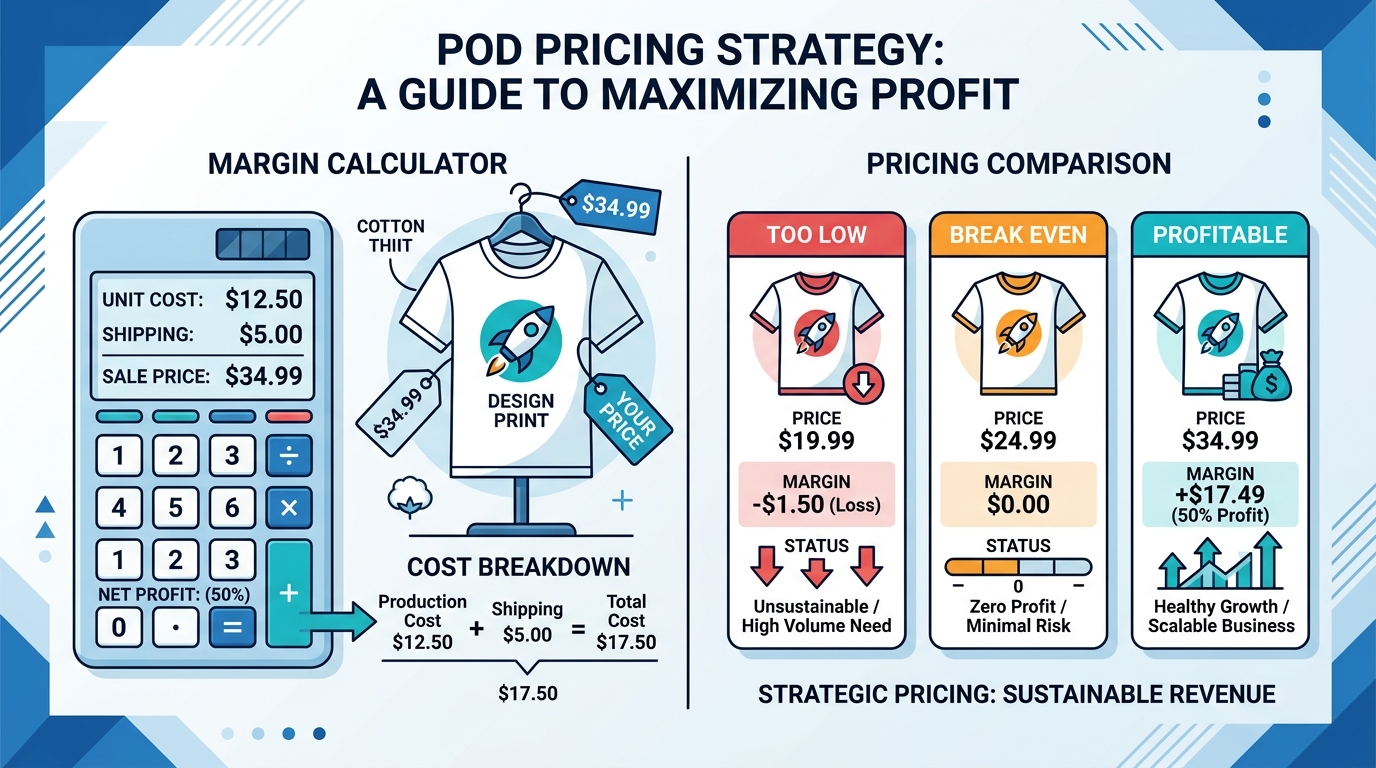
The POD pricing strategy guide explains the cost stack in more detail. If the store has not launched, use the AI print-on-demand startup guide for the earlier research, sample, and listing stages.
When does print-on-demand become maintenance-light?
Use operating gates rather than a month count. A shop that has been open for a year can still be chaotic. A small, focused catalogue with good documentation may be easier to run.
Gate 1: demand is observed
At least one product has repeat purchases from real, qualified traffic. Friends-and-family orders do not establish marketplace demand. Keep failed tests in the record so they are not quietly reinterpreted as proof.
Gate 2: the physical product has passed review
You have sampled the exact blank, colour, print method, and print provider. The listing images and care instructions match what arrived. Mockups help sell the idea, but they cannot reveal fabric feel, print texture, edge quality, or wash behaviour.
Gate 3: contribution is known
Actual statements, not catalogue estimates, show positive contribution after fulfilment, selling fees, advertising, and an allowance for problems. The store also has enough cash to fund orders before payouts.
Gate 4: routine orders complete automatically
The integration has processed normal variants, tracking has returned to the storefront, and notifications have reached buyers. Payment-failure and out-of-stock alerts go somewhere you check.
Gate 5: exceptions have a written response
Document what happens for a wrong address, cancellation, damaged print, lost parcel, size complaint, provider delay, takedown notice, and refund. Include who contacts the buyer, what evidence is collected, and when the issue is escalated.
Gate 6: maintenance has a calendar
Set recurring reviews for messages, failed orders, stock changes, listing accuracy, policy changes, product performance, and bookkeeping. “Passive” should never mean nobody is watching the store.
When all six gates hold, reduce intervention gradually. Do not automate a broken process just because the integration offers a switch.
Can AI make print-on-demand passive?
AI can make parts of the creative workflow faster. It can help explore visual directions, draft listing structures, remove a background, or create variants for a controlled test. It cannot tell you that a phrase is safe to sell, that a raster file will print cleanly at the chosen size, or that a buyer wants the product.
There are two practical constraints.
First, platforms can require disclosure. Etsy includes seller-prompted AI creations in its “designed by a seller” category, but requires AI use to be disclosed in the listing description. Second, authorship is not automatic. The U.S. Copyright Office's 2025 AI report says purely AI-generated material is not protected by copyright in the United States; human-authored selection, arrangement, or creative modifications may qualify case by case.
Keep the human work visible:
- write an original brief for a defined buyer;
- save prompts, source material, and edit history;
- redraw, typeset, compose, and correct the output;
- run a trademark and web search for meaningful phrases;
- inspect at final print size and order a sample;
- disclose AI and production assistance where the platform requires it.
The USPTO's federal trademark-search guide explains why an exact-word search is only a starting point and recommends checking similar wording and commercial impression. That is not a one-click guarantee of clearance. For a high-value brand or uncertain design, get advice for the countries where you sell.
MerchBanao can help generate and edit artwork, remove a background, preview a mockup, and export a high-resolution PNG. It does not supply demand, rights clearance, a platform approval, or a physical print guarantee. Use the AI t-shirt design generator for the creative stage and the print-ready design guide before sending a file to production.
The 30-minute weekly audit
Once the store is stable, give it a fixed weekly review. Thirty minutes is a review format, not a promise that every store only needs 30 minutes of work.
- 0–5 minutes: check failed payments, held orders, address issues, stock alerts, and delayed fulfilment.
- 5–10 minutes: review buyer messages, returns, reprints, tracking exceptions, and recent reviews.
- 10–15 minutes: compare visits, conversion, completed orders, contribution, and ad-attributed orders with the prior period.
- 15–20 minutes: pause listings with a quality, stock, rights, or negative-contribution problem.
- 20–25 minutes: record the owner time and the share of orders that needed manual work.
- 25–30 minutes: choose one next action, such as resampling a product, revising a main image, or testing one new audience-product pair.
If the review exposes several exceptions, do the work. The point of the timer is to make monitoring regular, not to abandon a buyer when the half hour ends.
Frequently asked questions
Is print-on-demand passive income?
Print-on-demand is not passive at launch. The seller still researches buyers, creates and checks designs, prepares listings, prices products, samples output, handles exceptions, and markets the store. A connected fulfilment service can automate routine production and tracking, so a proven catalogue may eventually become maintenance-light rather than completely hands-off.
Can AI make a print-on-demand business passive?
AI can shorten ideation, drafting, editing, and mockup tasks, but it cannot verify demand, guarantee intellectual-property clearance, inspect a physical sample, approve a refund, or protect cash flow. Treat AI as production assistance. The seller remains responsible for original input, accurate listings, platform disclosures, quality control, and customer outcomes.
How much can print-on-demand passive income earn?
There is no responsible universal earnings figure. Revenue depends on qualified traffic, conversion rate, average order value, fulfilment and shipping costs, platform fees, advertising, refunds, and taxes. Calculate contribution per order from your own statements, then multiply it by completed orders. Catalogue size alone does not predict earnings.
How much work does print-on-demand need after setup?
Measure the work instead of accepting a fixed hours-per-week promise. Track weekly operating hours, the share of orders needing manual intervention, customer-response time, refund or reprint rate, and contribution per order. A store is becoming maintenance-light when those figures stay controlled without missed messages, delayed orders, stale listings, or falling product quality.
Which platform is best for passive print-on-demand income?
No platform is best for everyone. A marketplace can supply buyer traffic but sets listing rules and charges selling fees. An owned store offers more control but makes the seller responsible for traffic and more of the customer journey. Choose using audience fit, total fees, payout timing, integration quality, policy obligations, and support workload.
The realistic answer
Print-on-demand passive income is possible only in the limited sense that routine fulfilment can continue without the seller touching every order. The store itself still needs judgment, monitoring, customer care, cash, and new demand.
Build for fewer manual touches, not for zero responsibility. Validate one product, sample it, document its contribution, watch the first orders, and write the exception playbook. If those pieces hold, automation can buy back time. If they do not, a bigger catalogue only gives the problems more places to hide.