POD Pricing Strategy: Cost, Margin, and Price Formula
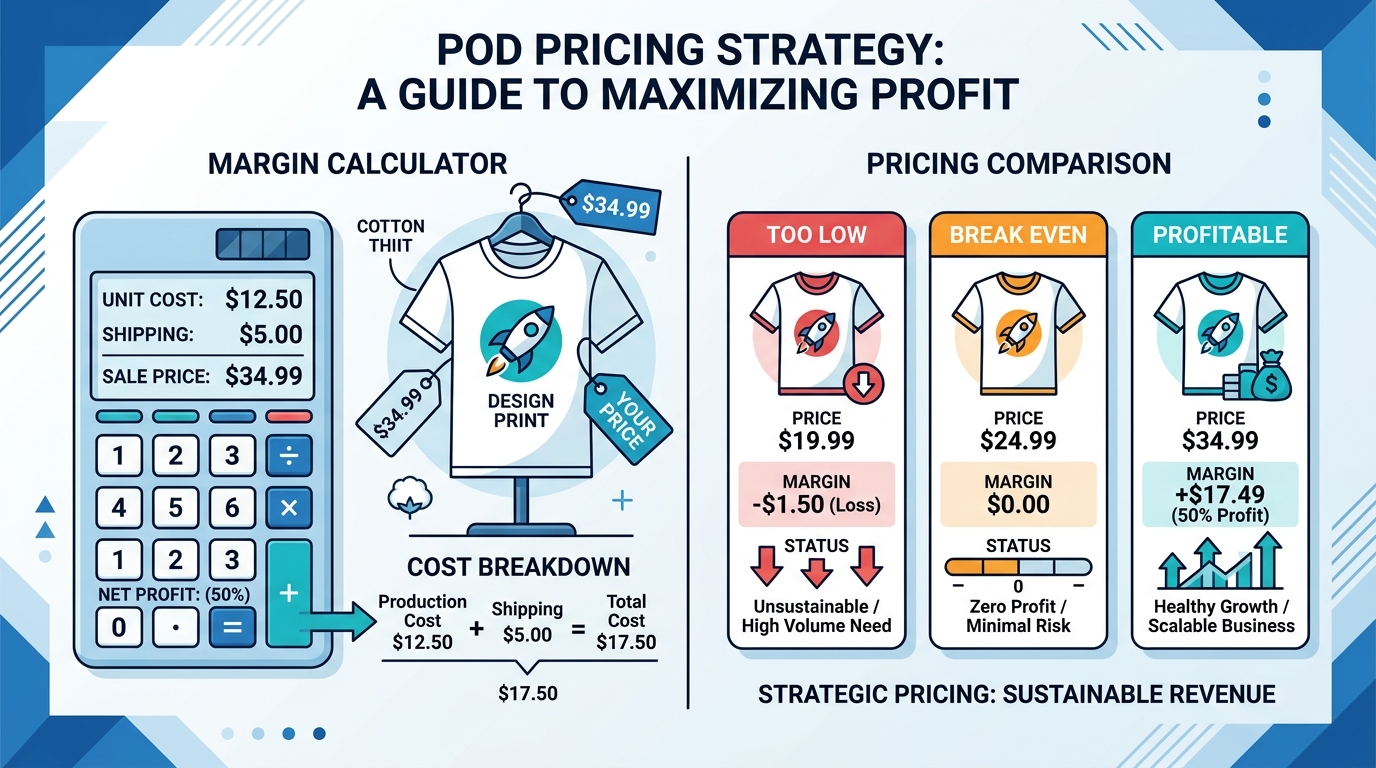
A sound POD pricing strategy starts with the amount a customer pays and subtracts every variable cost required to earn that order. Production cost alone is not enough. Provider shipping, marketplace fees, payment processing, discounts, advertising, refunds, and replacement risk all change the result.
There is no responsible universal price for a t-shirt or hoodie. The same blank can have different production costs by printer, colour, size, destination, subscription plan, and routing choice. Your sales channel changes the fee model again.
This guide is for a seller pricing an Etsy or owned-store product and for an artist checking royalties on Redbubble, TeePublic, or Amazon Merch on Demand.
The short formula
Contribution per order = customer revenue − all variable order costs
Set a price that leaves the contribution you need, then test whether qualified buyers accept the complete offer.
POD pricing terms that should not be mixed up
Three numbers answer different questions:
| Measure | Calculation | What it tells you |
|---|---|---|
| Gross margin | Revenue minus product production cost | A rough product-level view that omits selling costs |
| Contribution | Revenue minus all variable order costs | What one completed order contributes toward overhead, owner pay, and profit |
| Net profit | Revenue minus variable costs, fixed costs, tax, and other accounting expenses | What the business ultimately retains |
A supplier dashboard may label retail price minus production cost as “profit.” That can be useful inside the dashboard, but it cannot see every marketplace fee, advertisement, refund, or software expense. Treat it as an estimate until it is reconciled with actual statements.
The complete POD pricing formula
Use customer revenue as the starting point:
Customer revenue =
item price + shipping charged
Contribution per order =
customer revenue
− product production cost
− provider shipping
− marketplace and payment fees
− discounts funded by the seller
− advertising attributed to the order
− expected refunds, reprints, and chargebacks
Taxes collected and remitted by a marketplace may not be seller revenue. Income tax, VAT registration, fixed software, samples, accounting, and the seller's time need separate treatment for the business and country involved.
If every percentage fee uses the same revenue base, a simplified price-floor equation is:
Minimum customer revenue =
(fixed variable costs + target contribution)
÷ (1 − combined percentage-fee rate)
Real platforms are messier. A transaction fee, payment fee, advertisement, tax, and currency-conversion fee may use different bases. Calculate each line according to the live policy rather than adding percentages casually.
Use the POD pricing worksheet
Download the POD pricing worksheet, open it in a spreadsheet, and create one row for every product, printer, destination, and sales channel you plan to enable.
The worksheet separates inputs from results:
| Input | Source |
|---|---|
| Item price and shipping charged | Your listing |
| Production cost by variant | Live provider catalogue or order |
| Provider shipping | Exact product, quantity, and destination |
| Marketplace transaction fee | Current marketplace policy |
| Payment processing | Seller-country or payment-provider rate |
| Advertising | Attributed order or blended acquisition cost |
| Refund and replacement allowance | Your completed-order history |
| Target contribution | Your operating model |
Do not fill unknown cells with an industry average and forget about them. Mark them as assumptions, date them, and replace them after real orders arrive.
Worked example: an Etsy POD order
The following example shows the method, not a recommended shirt price:
| Line | Illustrative amount |
|---|---|
| Item price | $32.00 |
| Shipping charged to buyer | $0.00 |
| Customer revenue | $32.00 |
| Production cost | −$13.00 |
| Provider shipping | −$5.00 |
| Etsy transaction fee at 6.5% | −$2.08 |
| Listing or renewal fee | −$0.20 |
| Illustrative payment processing | −$1.21 |
| Refund/reprint allowance | −$0.75 |
| Attributed advertising | −$0.00 |
| Illustrative contribution | $9.76 |
The payment-processing amount is only a placeholder. Etsy says its processing rate combines a percentage and fixed amount that vary by country. An Offsite Ads order, currency conversion, regulatory operating fee, discount, larger garment size, or different shipping destination can change the contribution sharply.
At $32 in customer revenue, the example contribution rate is 30.5%. That percentage is not a target or a promise. The useful question is whether $9.76 covers the store's fixed costs and owner time while the offer still converts.
Etsy POD pricing: use the full fee stack
Etsy's current seller-fee guide lists:
- a $0.20 USD listing fee, including renewals and additional quantities in specified cases;
- a 6.5% transaction fee on the order amount, including shipping and gift wrap charged to the buyer;
- payment processing that varies by the country of the seller's bank account;
- a possible one-time shop setup fee that varies by location;
- possible Offsite Ads, currency-conversion, regulatory, deposit, advertising, and tax-related charges.
This is why “Etsy takes 6.5%” is incomplete. Download the monthly statement and reconcile a few real orders before treating the calculator as final.
The fulfilment transaction is separate too. Printify explains that the buyer pays the sales channel while the seller pays Printify for production and shipping from a linked method. A profitable order can still fail if the card or balance cannot fund production before the marketplace payout arrives.
Redbubble pricing: markup is not final earnings
Redbubble does not use the Etsy cost stack. Its current artist-payment explanation says:
- the base price includes Redbubble's service and third-party manufacturing costs;
- location, currency, discounts, and costs can change the base price;
- the artist markup defaults to 10%;
- base price plus artist margin produces the retail price;
- account fees can reduce the amount ultimately paid.
Raising markup increases the artist margin per full-price sale and also raises the retail price. It does not prove that total earnings will increase. Record views, conversion, sale type, artist margin, account fee, and completed payment before judging the change.
TeePublic pricing: use the earnings report
TeePublic controls retail pricing. The seller cannot apply the same markup model used on Redbubble. TeePublic's earnings documentation says earnings can change when:
- the account is categorized as Artisan, Apprentice, or Pending;
- the item sells during a sitewide sale;
- the sale occurs in a design's first 72 hours;
- a coupon or bundle affects the order.
The platform directs sellers to the current earnings chart and downloaded earnings report. Fixed payout claims copied from an older article are not a safe basis for planning.
Amazon Merch on Demand pricing: read the live royalty
Amazon Merch on Demand uses royalties rather than the Etsy-style seller cost stack. Amazon says the royalty is based on the product's offer price, less applicable tax and Amazon's costs.
Use the royalty shown for the exact product and marketplace in the current Merch dashboard. Do not assume that an old $19.99 example, a product from another country, or an upload tier predicts today's royalty.
Owned-store pricing
An owned Shopify, WooCommerce, or custom store gives the seller more control, not fewer costs. A complete model may include:
- payment processing and platform charges;
- provider production and shipping;
- apps, hosting, and subscriptions;
- discounts and affiliate commission;
- paid acquisition and creator fees;
- sales support, refunds, fraud, and chargebacks;
- tax collection and compliance;
- owner time.
Allocate fixed costs separately so you can see both order contribution and business profit. Dividing this month's software spend by this month's orders can help with planning, but it makes a young store's per-order figure swing wildly. Keep the raw numbers visible.
How to set a target contribution
Start from the business constraint, not an arbitrary “30% margin” rule.
- Estimate monthly fixed operating costs.
- Add a realistic amount for owner pay and retained profit.
- Estimate completed orders conservatively.
- Divide the required total by those orders to get a starting contribution target.
- Stress-test the result with lower conversion, a discount, a refund, and higher shipping.
- Reject a product if the required price is implausible for the offer.
This may reveal that a product should not be sold through a particular provider or channel. That is a useful result. A price calculator is allowed to say no.
Compare the market without copying the cheapest listing
Search the exact buyer phrase and compare credible products with similar blanks, personalization, reviews, shipping destinations, delivery promises, and image quality. The lowest visible price may be a sale price, a smaller size, a different garment, or a listing that charges shipping later.
Record the delivered price, not only the number in the search card. Then ask:
- Is the product materially different?
- Does personalization justify more work and value?
- Is the blank, print area, or fulfilment promise stronger?
- Can the required contribution fit inside the observed range?
If not, improve the offer, change the cost structure, or choose another product. Do not invent a premium that the listing does not earn.
Test a POD price without muddying the result
Price tests need enough qualified traffic to teach you something.
- Record the current price, shipping presentation, discount, images, and delivery promise.
- Choose one meaningful price change.
- Keep the main image, title, product, and audience stable during the test.
- Record impressions, product visits, add-to-carts, completed orders, refunds, and contribution.
- Run through comparable demand periods and note promotions or traffic changes.
- Compare total contribution, not conversion alone.
Testing $24.99 on one platform against $29.99 on another is not a clean price test. The audience, ranking system, fee model, and checkout all changed.
POD pricing checks before publishing
- Exact product, printer, size, colour, and destination costs recorded
- Provider shipping and any buyer shipping charge separated
- Marketplace transaction and listing fees included
- Country-specific payment processing included
- Advertising, discounts, refunds, and reprints modelled
- Cash required before payout checked
- Contribution dollars and percentage calculated
- Fixed overhead and tax treated separately
- Comparable delivered prices reviewed
- Assumptions dated and scheduled for reconciliation
Price from your costs, then let buyers answer
A useful POD pricing strategy produces two boundaries. The cost stack creates the floor. The offer and buyer response determine whether the market supports a price above it.
Download the POD pricing worksheet, enter one real product, and compare the result with the demand-validation workflow before expanding a catalogue. If the numbers only work when fees, shipping, refunds, or advertising are ignored, the price does not work.
Platform fee and earnings documentation reviewed July 26, 2026. Recheck live policies and account dashboards before changing prices.