AI Art for Print-on-Demand: Platform Guide (2026)
You can use AI art for print-on-demand when three conditions line up: the image tool gives you the needed commercial permission, the marketplace accepts the work under its current rules, and the design does not violate somebody else's intellectual-property or publicity rights. Those are separate checks. A platform accepting an upload does not prove that the artwork is safe to sell or protected by copyright.
This guide was reviewed on July 31, 2026. Policies and model terms change, so save the pages you relied on and recheck them before a large upload batch.
AI print-on-demand policy summary
| Platform | What the public policy says | Practical action |
|---|---|---|
| Etsy | Seller-prompted AI creations qualify as “designed by a seller”; AI use and production partners must be disclosed | Describe your creative role and printer accurately |
| Amazon Merch on Demand | No separate public AI-design rule found; content and IP rules apply | Check the dashboard policy and every listing field |
| Redbubble | Public agreement requires rights to uploaded content; no blanket AI permission found | Review User Agreement, content, and IP policies |
| TeePublic | Original uploads are allowed when the artist has the necessary rights; no blanket AI permission found | Review current artist-account rules before upload |
The phrase “no separate rule found” matters. It is not the same as “anything is allowed.”
What is the best print-on-demand platform for AI art?
There is no single best platform for every AI-assisted design. Etsy is the clearest of these four about seller-prompted AI work: its Creativity Standards place it in the “designed by a seller” category and require disclosure in the listing description. Amazon Merch on Demand, Redbubble, and TeePublic still require the necessary rights, but the public pages reviewed for this guide do not give the same explicit blanket answer about AI-generated artwork.
Choose from the business model as well as the policy:
| Your priority | Platform to investigate first | Check before uploading |
|---|---|---|
| Personalised products and a seller-run storefront | Etsy | AI disclosure, production partner, fees, and current Creativity Standards |
| Amazon marketplace reach without running fulfilment | Amazon Merch on Demand | Account access, content policy, metadata, IP, and quality rules |
| Artist marketplace with marketplace fulfilment | Redbubble | Current User Agreement, IP policy, account rules, and product margins |
| Artist marketplace with a curated-account system | TeePublic | Current upload guidance, account categorisation, rights, and royalties |
“Investigate first” is not an endorsement. Compare the live fee or royalty schedule, fulfilment regions, traffic sources, product range, account approval, and the work required to reach buyers. A platform policy can allow a file while the economics still make it a poor fit.
Does Etsy allow AI art for print-on-demand?
Yes, with conditions. Etsy's Creativity Standards place seller-prompted AI creations in the “designed by a seller” category. Etsy requires disclosure of AI use in the listing description. If Printify, Printful, Gelato, or another production partner prints and ships the product, that partner must also be disclosed.
Etsy does not allow standalone AI prompt bundles. It also expects the seller to play a clear creative role and represent the item accurately. That makes the workflow more important than pressing Generate once: write an original brief, curate outputs, edit the selected result, check the product, and explain what you did without pretending the item was hand-drawn.
Amazon Merch on Demand and AI-generated designs
Amazon's public Content Policies and intellectual-property FAQ, reviewed for this article, do not publish a separate AI-design permission. They do make the creator responsible for the rights needed to use the artwork and every part of the listing.
That includes more than the graphic. Product titles, brand names, bullet points, and descriptions can also trigger intellectual-property problems. A harmless-looking slogan may be protected for apparel. Use the Amazon Merch AI policy checklist before submitting a batch, and check the policy inside your account in case the public guidance has changed.
Redbubble and TeePublic AI-art policies
Redbubble's current User Agreement says sellers take on legal responsibilities when uploading content and incorporates its IP/Publicity Rights Policy and Community and Content Guidelines. We did not find a public Redbubble page granting blanket permission for AI-generated art.
TeePublic's upload guidance says artists can upload original work when they have the proper rights and do not violate another party's intellectual property. It does not turn AI output into automatically cleared content.
For both marketplaces, verify the live artist-account rules. Avoid uploading hundreds of lightly varied outputs. Even when a policy does not prohibit AI as a tool, repetitive or low-quality catalogues can create a poor buyer experience and may run into account-quality systems that are separate from the public IP rule.
Copyright is not the same as permission to sell
The U.S. Copyright Office's AI copyrightability report says material generated wholly by AI is not copyrightable in the United States. Human-authored expression can still qualify. Selection, arrangement, editing, painting over, and other creative modifications are assessed case by case.
This creates two different questions:
- Are you permitted to use the output under the model provider's terms?
- Can you stop somebody else from copying the AI-generated parts?
The first may be yes while the second is uncertain or no. Keep editable working files that show your human contribution. They are useful for production, disputes, and explaining what parts of a finished design you authored.
Copyright is also different from trademark and publicity rights. Do not use brand logos, fictional characters, celebrity likenesses, team marks, band names, or protected apparel slogans without permission. “The model generated it” is not a defence.
Use the T-shirt copyright and trademark checklist to trace asset licences, search phrases, review public-domain claims, and keep a pre-publish record.
Choose an AI tool by task, not hype
Use the ten-model t-shirt benchmark for displayed side-by-side evidence. The practical choices break down like this:
- For exact wording, generate the illustration and add the words as editable type.
- For detailed art, test the same prompt across two model families instead of trusting a general leaderboard.
- For isolated artwork, inspect the alpha channel. A white background is still a background.
- For a shorter production workflow, use a tool that combines generation, editing, removal, mockups, and high-resolution export.
- For commercial work, record the exact model, provider, plan, and terms. Open weights do not always include commercial rights.
No provider wins every prompt. Model names and preview endpoints also change faster than a product catalogue should.
How to prompt AI art for POD
A useful prompt tells the model what belongs in the composition and what does not. “Make a cool shirt” leaves almost every decision unresolved.
Working prompt structure:
Original subject + buyer or context + visual medium + composition + palette + production constraints + exclusions
Example:
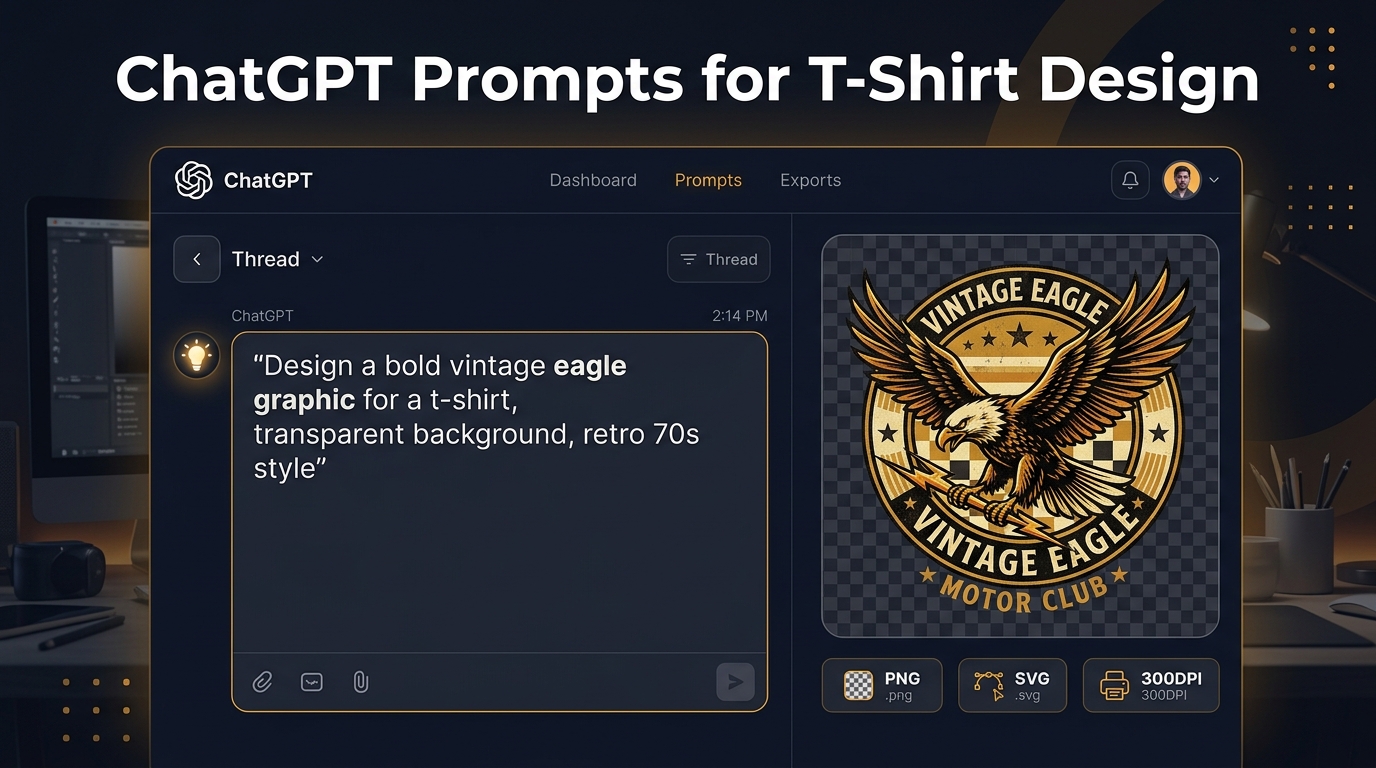
“Original sleepy heron for a birdwatcher's t-shirt, hand-cut linocut texture, centred vertical composition, three inks: cream, rust and dark teal, strong silhouette, no garment mockup, no words, no logo, plain removable background.”
That prompt asks for a removable background rather than claiming the file will contain transparency. After generation:
- Check anatomy, repeated shapes, lettering, and edge artifacts.
- Search distinctive phrases and visual elements.
- Add exact copy in an editor.
- Remove the background deliberately and inspect the alpha channel.
- Preview the artwork on the actual garment colour.
Avoid naming a living artist as a style shortcut. Describe the visual properties you need: ink texture, line weight, era, palette, lighting, composition, or printing method.
Prepare the AI image for print
Start with the fulfilment provider's product template. Required pixels are calculated from physical size:
width in pixels = print width in inches × requested pixels per inch
A 14 × 16 inch print area at 300 pixels per inch needs 4200 × 4800 pixels. Changing a 1024-pixel image's metadata from 72 DPI to 300 DPI does not add detail; it only changes the implied print size.
Use this production checklist:
- Choose the exact product, blank colour, and print area.
- Generate or import the artwork.
- Correct text and structural defects.
- Set the background intentionally; use real alpha when required.
- Resize or upscale to the provider's pixel dimensions.
- Inspect at 100% for ragged edges, tiny gaps, and invented detail.
- Export the requested format and colour space.
- Order a sample before scaling an important design.
MerchBanao exports a 4200 × 4800 PNG and keeps generation, canvas editing, background removal, and mockup preview in one session. The print-ready AI design guide explains the pixel math in more detail.
Is AI print-on-demand profitable?
AI lowers the cost of trying visual directions. It does not create demand, protect margins, or make a listing visible. Profit still depends on the sale price, fulfilment cost, marketplace fees, advertising, refunds, taxes, and the time spent operating the shop.
Use a contribution calculation before publishing:
contribution per order = sale price − fulfilment − platform fees − discounts − advertising − expected refund allowance
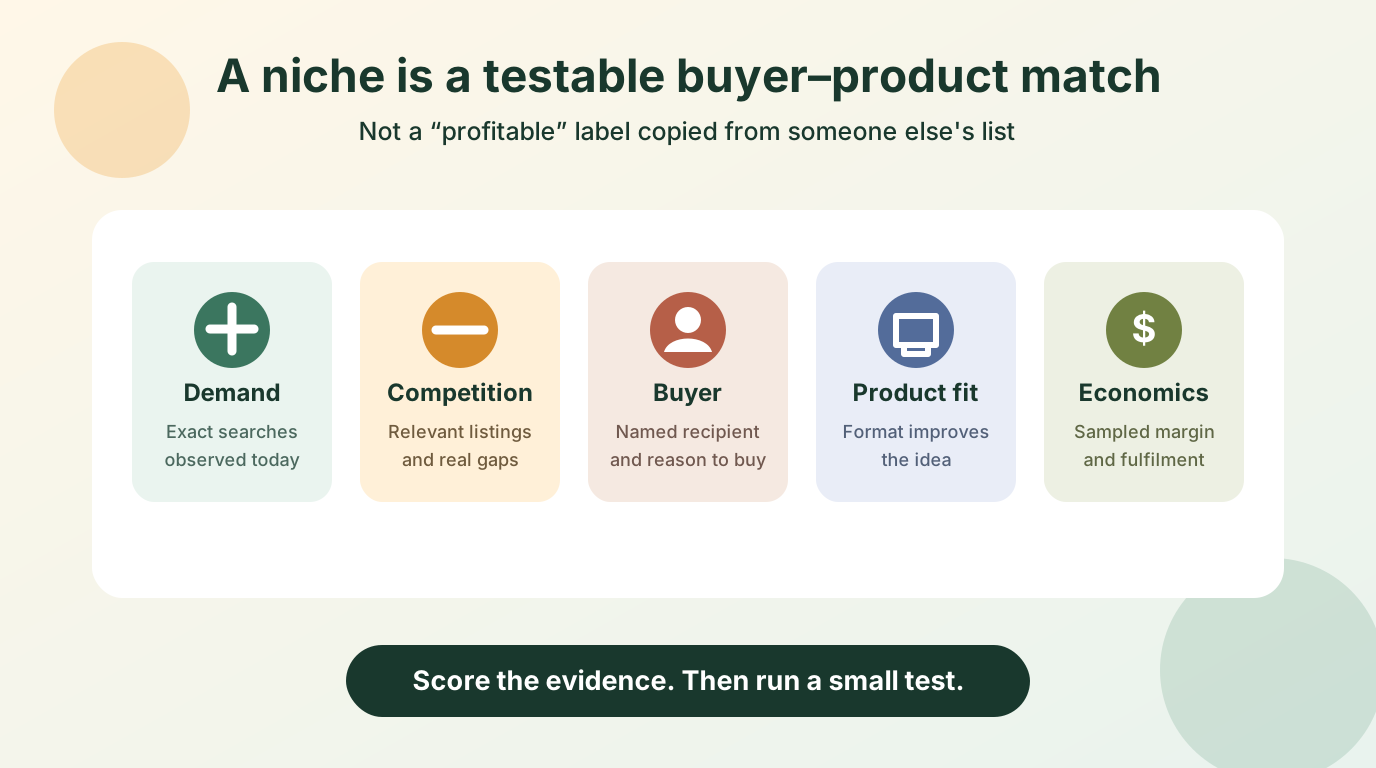
Then validate demand with a small collection. The merch demand-validation workflow shows how to combine marketplace evidence with store data. For 2026 creative directions, use the evidence-backed t-shirt trends as hypotheses, not guaranteed products.
AI art for POD preflight checklist
- The model provider and plan allow the intended commercial use.
- The prompt, source images, fonts, and added graphics are cleared for use.
- The design avoids protected brands, characters, people, and slogans.
- AI use and the production partner are disclosed where the marketplace requires it.
- The file matches the exact product template and contains enough pixels.
- Transparency, text, and small details have been inspected manually.
- The listing describes the real blank, print method, sizing, and care.
- The prompt, model, source files, edits, terms, and policy review date are saved.
- A sample has been ordered for work you plan to advertise or scale.
AI can make iteration faster. The durable advantage is still judgment: choosing a buyer worth serving, making an original composition, rejecting bad outputs, and shipping a file that prints the way the listing promises.