T-Shirt Design Copyright and Trademark Rules for POD Sellers
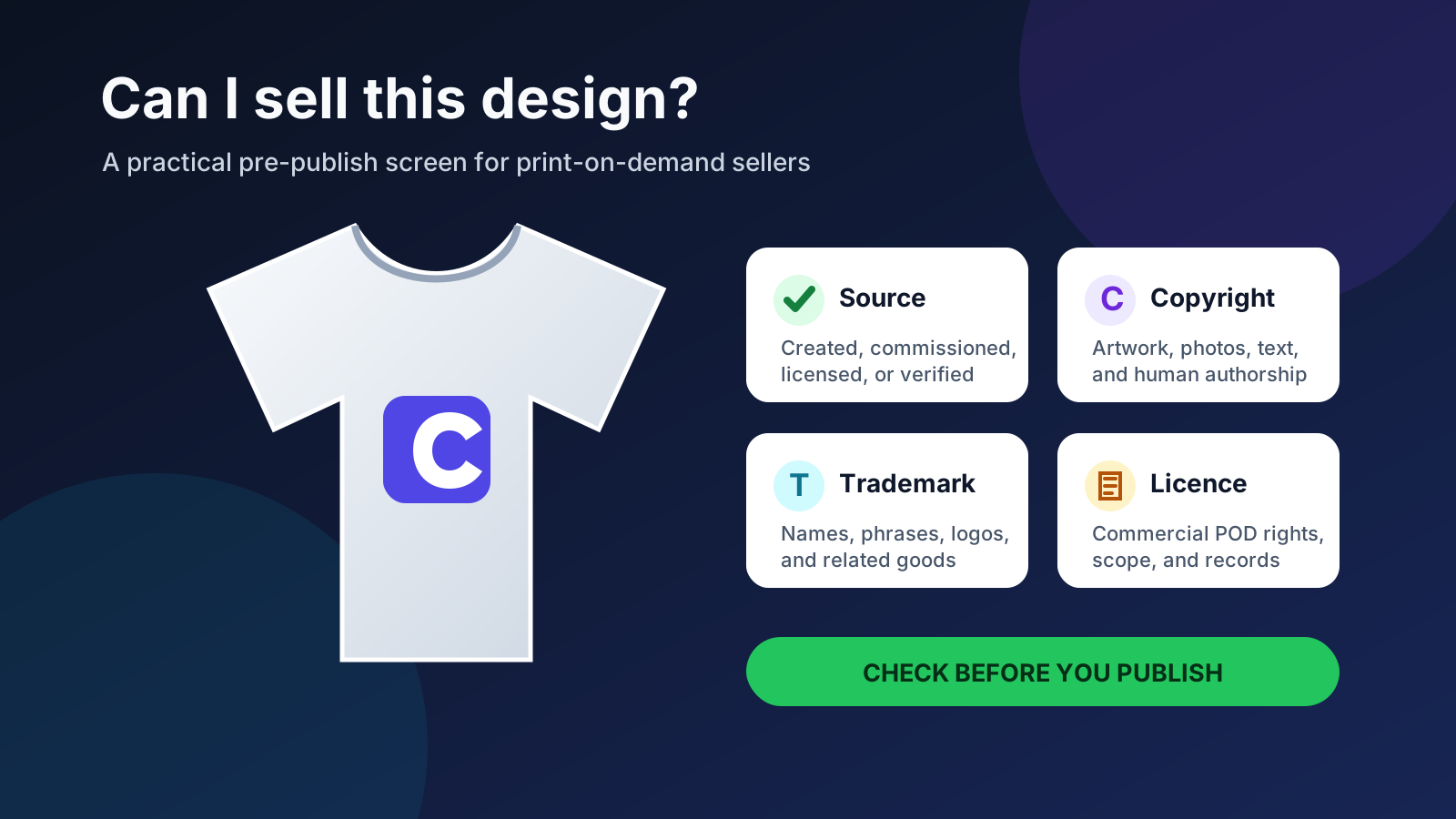
The short answer: sell artwork you created, commissioned with the necessary rights, or licensed for merchandise. Before publishing, check every visible element and every listing field for copyright, trademark, licence, and likeness issues.
A design can be original as a composition and still contain a protected logo. A short phrase may be too brief for copyright but still matter as a trademark. A stock image marked "commercial use" may allow advertising while forbidding products where the image supplies most of the value.
This guide focuses on practical U.S. screening for print-on-demand sellers. It is general information, not legal advice, and it cannot determine whether a specific design infringes someone else's rights.
Copyright, trademark, and licences are different checks
Start by separating the rights. Treating "copyright" as a catch-all is how sellers miss the real problem.
| Check | What it can cover | T-shirt example | First question |
|---|---|---|---|
| Copyright | Original creative expression fixed in a tangible form | Illustration, photograph, pattern, long written passage | Did I create this expression or obtain permission to reproduce it? |
| Trademark | A word, phrase, symbol, design, or combination that identifies the source of goods or services | Brand name, logo, product-line mark, source-identifying slogan | Could buyers think this product comes from, or is approved by, another source? |
| Contract or licence | The permission an owner grants under stated conditions | Stock-art licence, font licence, commissioned illustration agreement | Does the agreement cover POD merchandise and this exact use? |
| Publicity or privacy rights | Rights connected with a person's name, image, likeness, or identity, which vary by jurisdiction | Celebrity portrait, signature, recognisable private person | Do I have the permissions required for commercial merchandise? |
The U.S. Copyright Office says copyright generally begins when an original work by a human author is fixed in a tangible form. Registration is not required for protection to exist, although registration can provide important enforcement benefits.
The USPTO's trademark explanation makes a different point: a trademark does not give its owner control over a word or phrase in every setting. Rights relate to how the mark identifies particular goods or services and whether another use is likely to cause confusion.
Those two rules can overlap on one shirt. An illustrated mascot might involve copyright in the drawing and trademark rights in the character or brand identity.
Use a risk screen before you design
The cheapest problem to fix is the reference you never build around.
Lower-risk starting points
- Your own original drawings, photographs, lettering, and phrases
- A written commission that grants the commercial merchandise rights you need
- Assets whose current licence expressly covers your POD model
- Government or public-domain material whose exact status you have verified
- Basic facts, ideas, and themes expressed through your own creative work
"Lower risk" does not mean automatically clear. Your original phrase can resemble an existing mark. Your photograph can include a protected artwork, logo, or person's likeness. Run the finished design through the same checks.
References that need more investigation
- A purchased SVG, font, stock image, or template
- A quote whose source or length is uncertain
- Historical material labelled public domain without a date or provenance
- A client-supplied logo or photograph
- An AI output with a familiar-looking character, signature, product, or style
- A parody, commentary, or transformative-use theory
References that should stop the workflow
- A copied marketplace listing or bestseller
- An unlicensed film, game, comic, sports, music, or brand asset
- A celebrity image downloaded from search or social media
- Artwork carrying a watermark
- A logo with a few colours, letters, or shapes changed
- A licence that excludes merchandise, POD, resale, or commercial use
If a protected property is the reason a buyer would want the shirt, changing ten percent of the pixels is not a reliable clearance method.
A practical T-shirt design clearance workflow
No free search can promise that a design is safe. A repeatable screen can still catch obvious conflicts and create a record for decisions that need professional review.
1. Inventory every component
List the artwork, phrase, font, photograph, texture, logo-like device, reference image, and person shown. Include the title, brand field, description, tags, and mockup. Rights problems are not confined to the PNG.
For each component, record one source:
- created in-house;
- commissioned;
- licensed;
- public domain;
- supplied by a client;
- generated with AI; or
- not yet verified.
An unknown source is a reason to pause, not a blank to fill later.
2. Trace artwork and photographs
Use reverse-image search and ordinary web search to find earlier copies, portfolios, agency listings, watermarks, or brand associations. Then inspect the original source rather than relying on a repost.
If you commissioned the work, read the agreement. Paying an artist does not by itself answer which rights were transferred. Check who owns the copyright, whether the licence is exclusive or non-exclusive, which products and territories it covers, and whether you can modify the art or send it to a fulfiller.
3. Search phrases and brand elements
The Copyright Office's Circular 33 explains that names, titles, slogans, catchwords, and other short expressions are generally not protected by copyright. It also warns that some may be protected under trademark law.
Search the USPTO trademark database for:
- the exact phrase;
- spacing, punctuation, plural, and spelling variants;
- words that sound alike;
- translations or terms with a similar meaning; and
- marks that create a similar overall commercial impression.
Do not stop after finding no exact match in one clothing class. The USPTO says the key questions are whether marks are confusingly similar and whether the goods or services are related. It also says a comprehensive clearance search includes federal records, state registries, international sources where relevant, and internet searches for common-law use.
The USPTO federal-search guide is a useful starting point. Its comprehensive clearance guide explains why the federal database is necessary but not sufficient.
4. Read the actual asset licence
"Royalty-free" does not mean "free of conditions." The current licence controls.
Check these terms:
- commercial use;
- physical end products for sale;
- print-on-demand or made-to-order use;
- whether the asset can be the main value of the product;
- maximum copies or revenue limits;
- modification requirements;
- territory and duration;
- use in logos or trademarks;
- transfer or sublicensing to a printer; and
- restrictions on templates that let customers customise a product.
Save the receipt, licence text, asset page, creator name, and access date together. A bookmark is weak evidence if the seller later changes or removes the page.
5. Check the marketplace and fulfiller rules
Legal rights and platform permission are separate gates. A marketplace may remove material after a compliant report without deciding the final legal merits.
Etsy's current Intellectual Property Policy says sellers are responsible for having the necessary rights to their content. It also explains that Etsy removes or disables cited material when it receives a report that meets its process. Amazon Merch on Demand applies its own content, copycat, metadata, and quality rules, covered in the Amazon Merch AI policy checklist.
Read the policy for every market where the product will appear. A design accepted by one platform is not clearance for another.
6. Record the decision
Keep a small clearance record beside the source file:
| Field | Example record |
|---|---|
| Design version | Final-v4.png |
| Components reviewed | Illustration, phrase, font, mockup |
| Sources | Original sketch; font licence; commissioned lettering |
| Searches run | Exact phrase, close variants, related apparel use |
| Databases and markets | USPTO, web, target-country registry |
| Result date | Date reviewed |
| Decision | Continue, revise, license, or seek advice |
| Reviewer note | Why the decision was made |
This is not proof that no one has rights. It prevents a team from forgetting what it checked and publishing an old, unreviewed version.
Can you sell quotes and slogans on T-shirts?
Sometimes. The source and use matter more than the number of words.
A short everyday phrase may fall outside copyright protection, but it can still function as a trademark. A longer passage, lyric, poem, script line, or distinctive excerpt can raise copyright issues. Attribution does not replace permission. Changing punctuation or swapping one word does not necessarily change the analysis.
Ask:
- Is the wording copied from a song, book, film, speech, creator, or brand?
- Is it used as a source identifier for apparel or related goods?
- Are similar marks active or used commercially?
- Does the listing refer to the protected property even if the graphic does not?
- Is there a written licence for merchandise?
If the quote's recognisable connection to another creator or franchise is what drives the sale, do not treat "it is only text" as a defence.
Fan art, memes, and public-domain material
Drawing fan art from scratch does not erase rights in the character, logo, costume, story world, or other protected expression. Calling the work "inspired by" does not decide the issue. Commercial parody and fair use can be fact-specific legal arguments, not upload settings.
The Copyright Office's fair-use guidance says courts weigh four statutory factors case by case. There is no fixed percentage, number of changed elements, or word count that guarantees fair use. Commercial purpose is only one factor, but selling merchandise deserves careful review because market effect also matters.
Public-domain material needs its own verification. Confirm the status of the exact work in the country where you are selling. A nineteenth-century painting may be public domain while a modern photograph of it, edited scan, translation, logo treatment, or branded character use raises a separate question.
When the evidence is unclear, replace the reference with an original concept or obtain a licence. That is usually cheaper than building a catalogue around an unresolved assumption.
What changes when AI helps make the design?
AI adds two checks; it does not remove the earlier ones.
First, review the tool's current terms for commercial use, input rights, output rights, and prohibited content. Save the version that applied when the image was generated.
Second, inspect the output itself. Look for:
- recognisable characters, logos, products, packaging, or uniforms;
- artist signatures or watermarks;
- copied-looking compositions;
- celebrity or private-person likenesses;
- protected phrases in generated lettering; and
- source images you did not have permission to upload.
The U.S. Copyright Office's AI copyrightability report says purely AI-generated material is not protected by copyright and that prompts alone generally do not provide enough control over expressive elements. Human-authored selection, arrangement, modifications, and perceptible expression may be protected when they meet the normal requirements, assessed case by case.
That is about whether you can claim copyright in the result. It does not say the result cannot infringe someone else's work or mark.
Use AI as part of a documented creative process. Keep the prompt, raw outputs, edits, typography, layered file, final export, and terms snapshot. The AI art for print-on-demand guide explains the broader production workflow.
Seven common myths that fail a preflight check
"I changed 30 percent, so it is mine"
There is no universal percentage that converts copied work into safe merchandise. Compare protected expression, not a made-up edit threshold.
"I credited the artist"
Credit can be courteous, but it is not a substitute for a licence when permission is required.
"It was on Google, Pinterest, or social media"
Being publicly visible does not place a work in the public domain or grant commercial product rights.
"There is no copyright symbol"
Copyright can exist automatically without a notice or registration.
"The trademark record is dead"
A cancelled, expired, or abandoned federal record does not prove that no one has current common-law rights or another relevant registration.
"Other sellers are doing it"
Another listing may be licensed, unreported, under review, or infringing. Its existence tells you little about your rights.
"The generator gave me the image"
Tool access, ownership language, commercial-use permission, copyrightability, and third-party infringement are separate questions.
A pre-publish checklist for POD sellers
Before the product goes live, confirm:
- Every artwork element has a recorded source.
- Commission and asset licences cover commercial POD merchandise.
- The phrase and close variants were searched for related goods and services.
- Web and marketplace searches did not reveal an unresolved source conflict.
- No unlicensed character, logo, celebrity, song lyric, or copied listing appears.
- The title, brand field, tags, description, and mockup passed the same review.
- AI inputs, outputs, edits, and applicable terms were saved.
- The target marketplace and fulfilment policies were checked.
- Unclear or high-value uses were removed, licensed, or reviewed by a qualified attorney.
Then perform the production checks. Legal clearance does not fix a blurry file, weak contrast, or incorrect print area. Use the print-ready T-shirt design guide before ordering a sample.
Protecting your own T-shirt artwork
Keep original sketches, source files, layer history, contracts, invoices, export dates, and publication records. These materials help establish provenance and make revisions easier.
Copyright can exist automatically in qualifying human-authored artwork, but U.S. registration offers additional benefits. Use the official Copyright Office registration portal and its current guidance rather than a third-party form that promises a shortcut.
If you are building a brand, trademark protection is a different project. A large slogan across the front of a shirt may be perceived as decoration rather than as a source identifier. The USPTO explains this issue in its ornamental refusal guidance. A trademark attorney can help assess clearance, ownership, filing strategy, and how the mark is actually used.
Make clearance part of the design brief
Do not wait until upload day to ask whether you can sell the design. Start with a documented source, screen the phrase before polishing it, read every licence, and review the final artwork and listing together.
The goal is not to collect a folder of screenshots and declare zero risk. It is to catch avoidable problems early, know which assumptions remain, and send genuinely uncertain commercial decisions to someone qualified to evaluate them.