How to Scale a Print-on-Demand Business Without Losing Profit
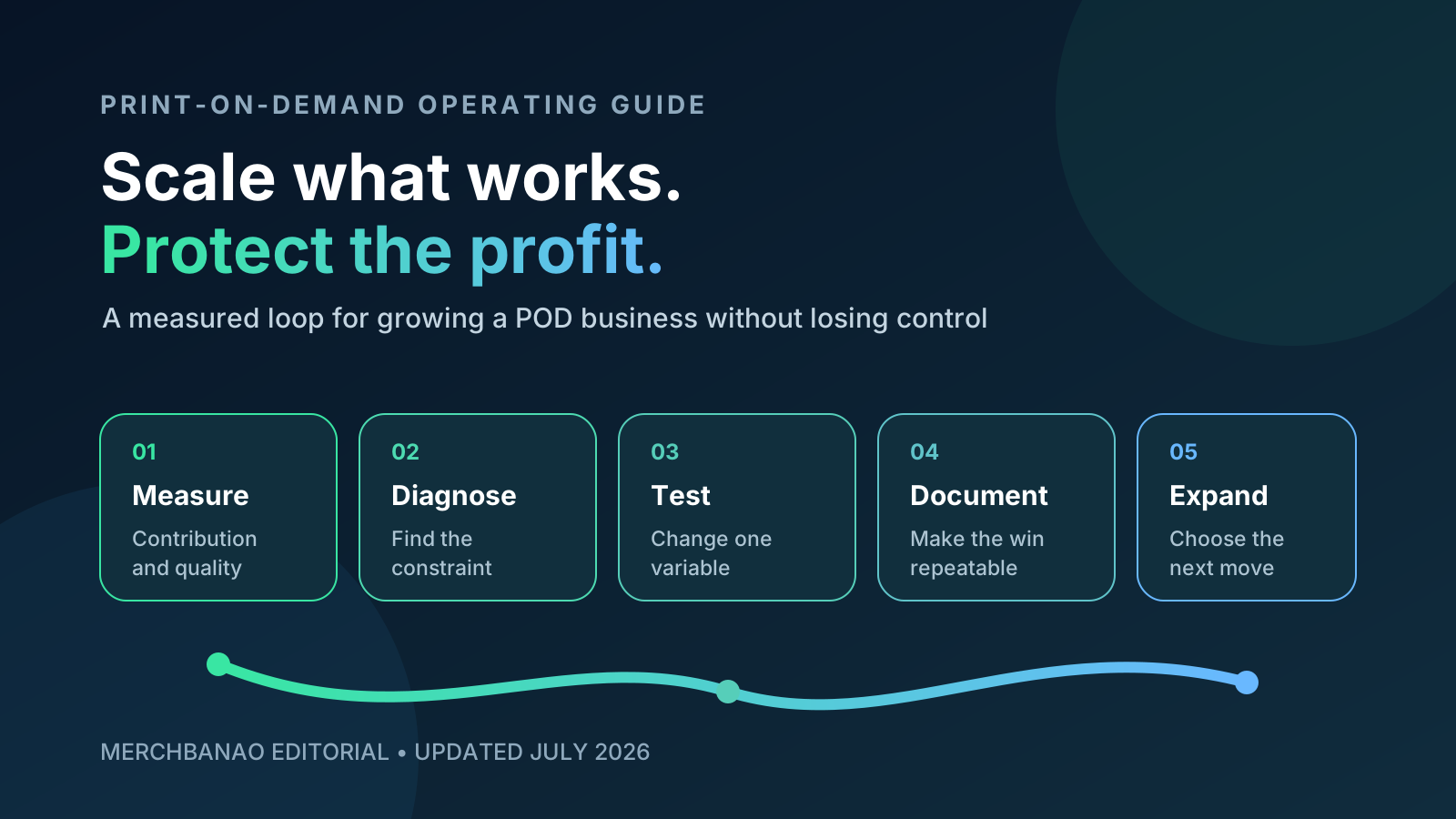
To scale a print-on-demand business, repeat a product and buyer combination that already produces positive contribution, then remove the next constraint without letting quality or costs drift. More listings, more ads, and more marketplaces are inputs. They are not proof that the business has scaled.
This guide is for sellers who have real traffic or orders and need a safer POD scaling strategy. If the store has not made a sale yet, use the print-on-demand business guide and demand-validation workflow first.
In practical terms, the scalability of a print-on-demand business depends on whether contribution, fulfilment, and customer experience hold up as order volume increases.
What this guide covers
- the numbers to record before expanding;
- a practical five-stage scaling loop;
- how to choose between more designs, products, ads, and channels;
- a worked contribution example;
- a 90-day operating plan.
The short version
- Calculate contribution by order, not store-wide revenue.
- Find one repeatable buyer, design concept, product, and channel combination.
- Diagnose the current constraint.
- Change one major variable at a time.
- Document the winning workflow before adding volume.
- Expand only while contribution, fulfilment, and customer experience remain healthy.
That sounds slower than uploading hundreds of products at once. In practice, it wastes far less time.
Measure the baseline before you scale
A store is ready to grow when its owner can explain where an order came from, what it contributed, and what went wrong when it needed support. Start with a simple weekly scorecard.
| Measure | What it tells you | Useful breakdown |
|---|---|---|
| Qualified visits | Whether relevant people reach the listing | Query, channel, listing |
| Conversion rate | Whether the offer turns visits into orders | Product, device, country |
| Collected revenue | What the customer paid before costs | Product, discount, shipping |
| Contribution per order | Cash left after variable order costs | Variant, destination, source |
| Refund or reprint rate | How often quality or fulfilment fails | Supplier, blank, print method |
| Fulfilment time | Whether delivery promises are realistic | Provider, region, season |
| Support minutes per order | The hidden labour created by growth | Issue type, product |
Revenue alone hides too much. A discounted hoodie sold through an ad to a distant country can have a very different result from an organically discovered local t-shirt order.
Calculate contribution before increasing volume
Use this order-level formula:
Contribution = item revenue + shipping charged − production − fulfilment shipping − marketplace fees − payment fees − advertising − expected refund or reprint allowance
Taxes need separate treatment based on where the business and buyer are located. Fixed software, samples, contractors, and the owner's time belong in the wider operating model. The POD pricing strategy guide covers that worksheet in more detail.
Printful's pricing documentation confirms that its displayed product price can exclude shipping, taxes, extra placements, larger-size charges, and other options. Etsy's current fee policy likewise includes several possible charges rather than one universal marketplace percentage. Pull live figures from the exact product and account instead of copying a margin from somebody else's video.
A worked example
Suppose an illustrative order collects $32 for the item and $5 for shipping.
| Line | Amount |
|---|---|
| Collected revenue | $37.00 |
| Production | −$13.00 |
| Fulfilment shipping | −$4.50 |
| Marketplace and listing fees | −$2.60 |
| Payment processing | −$1.40 |
| Advertising attributed to the order | −$4.00 |
| Reprint and refund allowance | −$1.00 |
| Contribution | $10.50 |
The example contribution margin is $10.50 ÷ $37.00, or 28.4%. These are sample numbers, not a benchmark. Replace every line with current account data.
The same sheet sets an advertising ceiling. Before advertising, the example leaves $14.50. Spending the full $14.50 to acquire the order would leave nothing for fixed costs or the owner. If the target is at least $8 contribution, the maximum acquisition spend is $6.50.
How to scale a print-on-demand business in five stages
1. Find the repeatable unit
Do not scale “the shop.” Scale a specific unit:
buyer + design promise + product + channel + acquisition source
“Dog shirts” is too broad. “Personalised memorial sweatshirt for a recently bereaved Labrador owner, found through Etsy search” is measurable. It also gives you sensible adjacent tests: another garment, another dog breed, or another design treatment.
Look for repeated behaviour, not one lucky order. A listing with qualified visits, several purchases, acceptable contribution, and no recurring production issue is a better candidate than a viral post that produced attention but no buying signal.
2. Name the constraint
Every growth plan should answer one question: what currently stops the proven unit from producing more good orders?
| Signal | Likely constraint | First test |
|---|---|---|
| Few relevant impressions | Discovery | Query fit, category, attributes, channel |
| Impressions but few clicks | Presentation | Main image, title clarity, price framing |
| Clicks but few orders | Offer | Product, trust, delivery, sizing, total price |
| Orders but weak contribution | Economics | Costs, discounts, price, ad spend |
| Healthy sales but support spikes | Operations | Instructions, supplier, variants, QA |
| One product carries the store | Concentration | One adjacent product or buyer need |
This prevents a common mistake: responding to weak conversion by publishing more designs. More inventory multiplies an unresolved offer problem.
3. Run one controlled expansion
Choose one primary variable for the test. Keep the rest as stable as practical.
- To test a design extension, keep the buyer, product, price, and channel stable.
- To test a new product, use a design with known demand.
- To test a higher price, keep the product and acquisition source stable.
- To test paid traffic, start with a listing that already communicates the offer clearly.
- To test a new channel, move a small set of proven products and rebuild the listings for that channel.
Write down the hypothesis, the main metric, a loss limit, and the date you will review it. There is no universal number of clicks or days that makes every test conclusive. High-priced, seasonal, and low-volume products need different windows.
4. Turn the winner into an operating procedure
Growth gets messy when the useful decisions live in somebody's memory. Document:
- the approved artwork and print-area specifications;
- naming, version, and licensing records;
- product and supplier settings;
- mockup and listing requirements;
- price floors and discount limits;
- sample approval notes;
- order-routing and exception handling;
- customer reply templates;
- weekly scorecard ownership.
AI can speed up ideation and production work, but it does not validate demand or inspect a physical sample. Use the AI t-shirt design generator to develop distinct directions, then check the final asset against the provider template and order the product you intend to sell.
5. Expand to the next adjacent opportunity
Pick the move that answers a business need.
- Add a related design when the same buyer has another clear occasion or identity.
- Add a product when buyers want another format and the print method suits it.
- Add a channel when it reaches a distinct audience or reduces material platform risk.
- Add paid acquisition when the contribution model can support it.
- Add help when a documented task repeatedly consumes the owner's time.
Platform diversification is not automatically safer. A second marketplace adds another fee structure, policy set, search system, support queue, and reconciliation job. The Redbubble vs Etsy comparison shows how different those operating models can be.
Use marketplace data without chasing the algorithm
On Etsy, query matching draws from titles, descriptions, tags, categories, and attributes. Etsy's 2025 keyword guidance recommends clear, buyer-friendly titles and says the system considers listing information holistically. It specifically warns against long strings of repeated keywords.
That changes the scaling job. Copying one keyword-stuffed title onto 50 similar listings is not a strategy. Use the buyer's language accurately, differentiate the products, and watch how people respond.
Ads deserve the same discipline. Etsy says its onsite ads are charged per click, with cost varying by listing and placement. Set a daily budget that fits the test, but also set a maximum total loss and a required contribution per acquired order. A return-on-ad-spend figure can look healthy while production and marketplace costs erase the order's cash contribution.
Protect fulfilment and customer experience
The first orders can be handled manually. Ten times the volume exposes every vague instruction and fragile workaround.
Before increasing traffic:
- sample the exact high-volume product and colour;
- confirm current production and shipping estimates by destination;
- test address, artwork, payment, and routing failures;
- keep enough cash or available credit to fund fulfilment before marketplace payouts arrive;
- define who handles reprints, refunds, and customer messages;
- retain a second supplier only after sampling its version of the product.
Watch rates, not just counts. Five complaints after 50 orders are more alarming than five after 5,000. Break the issues down by supplier, product, size, colour, destination, and design placement so the fix targets the real source.
A practical 90-day POD scaling plan
This is an operating cadence, not an earnings promise.
Days 1–30: establish the truth
- reconcile the last several weeks of orders;
- calculate contribution by product and acquisition source;
- identify the best repeatable unit;
- list the top three constraints;
- sample the product again if its supplier, blank, or artwork changed.
Days 31–60: remove one constraint
- choose one controlled test;
- set the metric, review date, and loss limit;
- leave unrelated variables alone;
- record customer questions and fulfilment exceptions;
- stop, revise, or continue based on the result.
Days 61–90: make the result repeatable
- document the winning workflow;
- automate a stable administrative step, not an unresolved decision;
- run one adjacent product, design, price, or channel test;
- review contribution and service quality weekly;
- decide what not to scale.
That last decision matters. A product can sell and still be a poor scaling candidate because it attracts expensive support, inconsistent printing, or weak cash contribution.
The final scaling check
Before adding volume, answer these questions with store data:
- Which exact buyer-product-channel unit are we repeating?
- What is its contribution after all variable costs?
- What is the current constraint?
- What single change are we testing?
- What loss or quality threshold stops the test?
- Can the fulfilment and support workflow absorb success?
That is how to scale a print-on-demand business without confusing activity with progress. Keep the unit economics visible, make one meaningful change at a time, and let verified customer behaviour decide what earns the next investment.