Redbubble vs Etsy for POD: Fees, Control and Best Fit
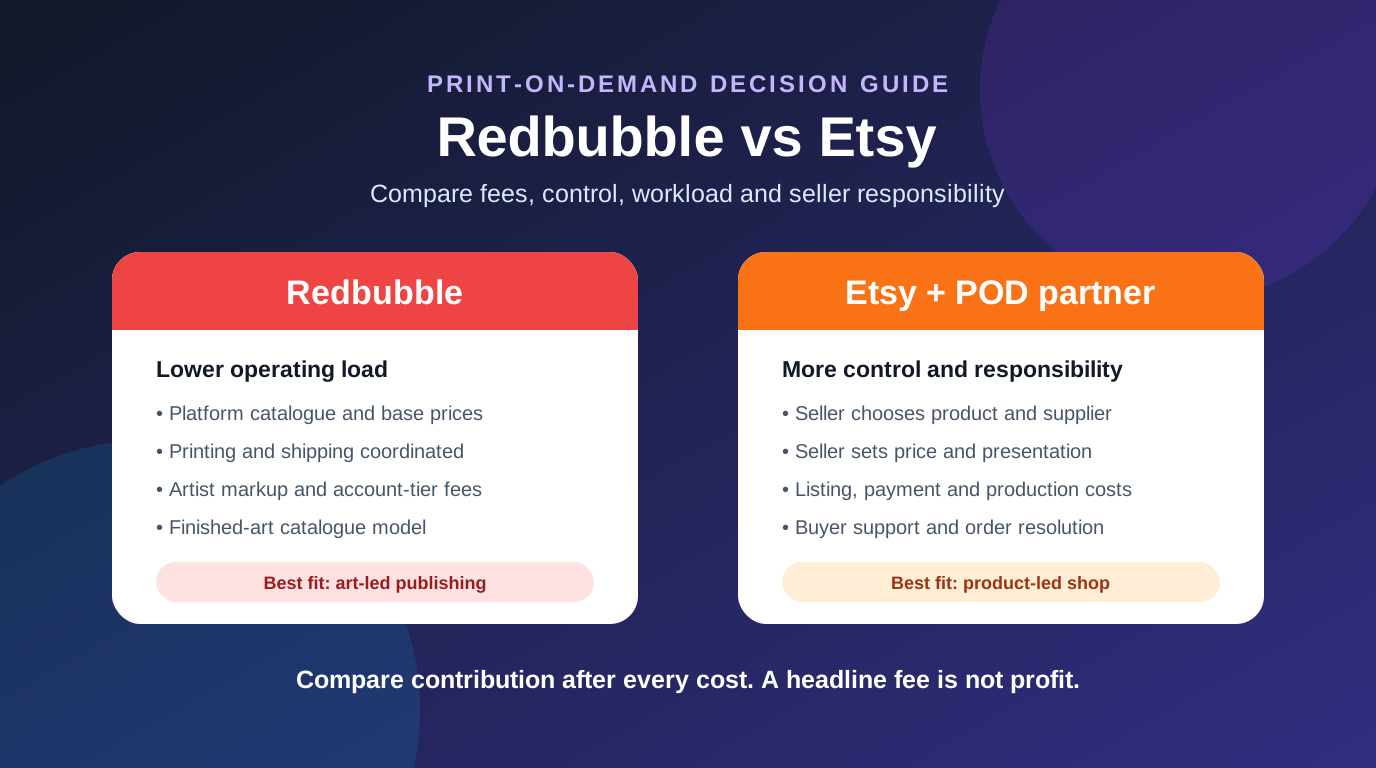
Redbubble vs Etsy is really a choice between two operating models. Redbubble is the lighter one: upload original work, choose products and let its marketplace coordinate checkout, third-party printing, shipping and buyer support. Etsy gives a POD seller more control over the offer, but the seller must choose and disclose a production partner, build the listing, fund fulfilment and deal with customers.
For a beginner who wants to publish art without running order operations, Redbubble is the easier starting point. For a seller who wants to choose garments, set the price, offer personalisation and shape the whole listing, Etsy is usually the better fit. Neither platform is automatically more profitable.
This guide is for artists and small POD sellers choosing a first channel or deciding whether a second channel is worth the extra work. Fee and policy sources were checked on July 25, 2026.
Quick comparison
| Decision factor | Redbubble | Etsy with a POD partner |
|---|---|---|
| Basic model | Artist marketplace with products and fulfilment coordinated by Redbubble | Seller-run marketplace shop connected to a separate producer |
| Upfront listing charge | No listing charge in the current account-fee policy | $0.20 per listing or renewal |
| Main sale economics | Base price plus artist markup, followed by applicable account fees | Seller revenue minus production, shipping, Etsy and operating costs |
| Current platform fee | Standard 50%, Premium 20%, Pro 0% of monthly earnings | 6.5% transaction fee; payment processing varies by bank country |
| Product choice | Redbubble's available catalogue and print options | Products available from the seller's chosen qualifying partner |
| Retail-price control | Markup control over Redbubble's base price | Seller sets the listing price |
| Listing presentation | Upload flow applies the work to enabled products | Seller supplies listing details, photos or mockups, variants and policies |
| Personalisation | Limited by the marketplace product flow | Can be built into eligible Etsy listings and supplier workflow |
| Buyer issues | Redbubble's Customer Success flow handles marketplace returns and exchanges | Etsy expects the seller to respond and resolve order issues |
| Payout timing | Monthly cycle after shipped earnings reach $20, £20 or €20 | Depends on Etsy Payments country, deposit schedule and account status |
| Best fit | An art-led catalogue with low operational appetite | A product-led shop that can support customers and manage contribution |
The table compares responsibilities, not traffic or expected sales. Marketplace visits are not the same as impressions for your work.
What “Redbubble vs Etsy” gets wrong
Many comparisons put a royalty percentage next to Etsy's transaction fee and declare a winner. That does not work. Redbubble starts with a base price that already includes marketplace and manufacturing costs, then calculates an artist margin. Etsy lets the seller collect the order revenue, but that seller still has to pay a producer and absorb the rest of the order costs.
The useful question is narrower: after every cost and responsibility is counted, which model fits this product and this seller?
Use the table of contents to jump to the part that matters:
- Current Redbubble fees
- Current Etsy POD fees
- Worked fee examples
- Workload and control
- Decision scorecard
- Selling on both
- FAQs
Redbubble fees and earnings in 2026
Redbubble's payment calculation guide separates base price, artist margin and retail price. The base price includes Redbubble's marketplace service and the charge from its third-party manufacturer. Your markup is a percentage of that base price; the cash result is the artist margin. The default markup is currently 10%.
That displayed margin is not necessarily the final amount. The same help page lists these platform fees:
| Redbubble account tier | Platform fee on monthly earnings | Excess-markup fee |
|---|---|---|
| Standard | 50% | 50% of earnings from markup above 20% |
| Premium | 20% | 50% of earnings from markup above 20% |
| Pro | 0% | 0% |
Redbubble says the excess-markup fee only applies to the part of the markup above 20%, and total account fees are capped at $150, €150 or £150 per month. Its account-fee page was updated March 17, 2026 and says Standard and Premium fees apply only when the artist makes sales during the pay period.
There are two easy traps here. First, a 20% markup is not a 20% margin on the final retail price; it is 20% of the base price. Second, sitewide and volume discounts can change the base price used in the calculation. Use the amount shown in your sales history, not an old spreadsheet.
Redbubble begins its monthly payment cycle after shipped earnings, net of applicable account fees, reach $20, £20 or €20. Its independent artist guide says the process starts near the beginning of the month and should arrive by the 15th, subject to processing and account details.
Etsy fees and POD costs in 2026
Etsy is not the printer in a typical POD setup. The seller creates the listing and uses a separate production partner to make and dispatch the product. Etsy's production-partner guidance names print-on-demand services as a valid partner type when they produce the seller's original design. The partner must be disclosed on the relevant listing, and the dispatch location must be accurate.
Etsy's Fees and Payments Policy was updated February 13, 2026. The core charges for this comparison are:
- a possible one-time shop setup fee, shown during onboarding;
- $0.20 for each listing or renewal, normally covering four months;
- a 6.5% transaction fee on the displayed item price plus charged shipping and gift wrapping;
- Etsy Payments processing, which varies by the location of the seller's bank account.
Those are not the whole cost stack. Currency conversion and regulatory operating fees can apply in some countries. Etsy Ads are optional. Offsite Ads are different: Etsy's Offsite Ads guide says an attributed order is charged 15% if the shop has always made less than $10,000 USD in any consecutive 365-day period. Those shops can opt out. Once a shop has reached $10,000 USD in a consecutive 365-day period, participation becomes required for the life of the shop and the rate is 12%.
Then come the costs outside Etsy: blank product, printing, supplier shipping, taxes where relevant, refunds, replacements and any subscription paid to the production service. A shop can show positive revenue and still have weak contribution.
Worked examples with visible assumptions
These examples explain the arithmetic. They do not predict your result, and they are not meant to compare the exact same shirt.
Redbubble example
Redbubble's own guide uses a U.S. Classic T-Shirt with a $20 base price and 20% markup:
- Artist margin before account fees: $20 × 20% = $4.
- Retail price before indirect tax: $20 + $4 = $24.
- Standard account platform fee: $4 × 50% = $2.
- Standard net artist earnings in this simplified example: $4 - $2 = $2.
At the same base price and markup, the simplified result would be $3.20 for Premium and $4 for Pro. There is no excess-markup charge because the markup does not exceed 20%. Discounts, tax and local base-price differences can change the live result.
Etsy example
Suppose an Etsy POD seller charges $30 for an item and $5 for shipping. The POD supplier charges $18 for the product and delivery. Ignore tax for this illustration and insert your own country-specific payment-processing rate later.
| Line | Calculation | Amount |
|---|---|---|
| Revenue collected | $30 item + $5 shipping | $35.00 |
| POD product and delivery | Assumption from live supplier quote | -$18.00 |
| Etsy transaction fee | $35 × 6.5% | -$2.28 |
| Listing or renewal | Current fixed charge | -$0.20 |
| Contribution before processing, ads and support | $35 - $18 - $2.28 - $0.20 | $14.52 |
Now subtract payment processing. If that order is attributed to an Offsite Ad, the example also loses $5.25 at 15% or $4.20 at 12%. Refunds, reprints, currency conversion and regulatory charges are still absent.
This is why “Etsy only takes 6.5%” is not a usable profit statement. It is also why Redbubble's 20% markup cannot be compared directly with Etsy's 6.5% fee.
Use the POD pricing strategy guide to build a complete contribution sheet for an Etsy product.
Who does the work after a sale?
Redbubble routes orders to third-party printers. Its current shipping-origin guide says the fulfiller is selected using destination and product type, so one order can arrive in separate packages. Buyers use Redbubble's Customer Success flow for qualifying exchanges. The artist still has work to do, of course: make original art, prepare uploads, title and tag the work, select products, set markups and keep the account compliant. “Upload and forget” is a poor description.
On Etsy, the seller is the buyer's first operational contact. The Etsy Seller Policy effective July 9, 2026 requires accurate production and dispatch information, timely responses, honoured processing times and direct resolution of order issues. Your POD integration may transmit the order to a printer, but it does not transfer those seller obligations.
That difference becomes concrete when an address is wrong, a parcel is late or the print is defective. A Redbubble artist usually does not negotiate the resolution with the buyer. An Etsy seller checks the order, messages the customer, talks to the supplier and decides whether to replace, refund or use Etsy's case process.
Pick the work you are willing to repeat. One Etsy order is manageable. A holiday queue of personalised orders is a different business.
Pricing, products and presentation
Redbubble controls the product catalogue and calculates retail price from its base price plus your markup. Its uploader can enable or disable products based on the artwork file, and you adjust the placement for each enabled item. This is quick, but you cannot replace the underlying garment with a supplier of your choice.
An Etsy seller can compare qualifying production partners, choose a specific garment and set the retail price. The tradeoff is a longer listing workflow. Etsy's listing guide currently has seven form sections and allows up to 20 photos plus two short videos. More control means more decisions and more ways to misrepresent a product if the mockup, colour or shipping details are inaccurate.
Personalisation is the clearest Etsy use case. If the buyer can change a name, date, role or pet portrait, the seller can build that input into the listing and route an approved file to the producer. Redbubble is better treated as a catalogue of finished artwork applied to its available products.
For Etsy-specific artwork and listing preparation, use the Etsy T-shirt design guide. For Redbubble file setup and publishing, use the how to sell on Redbubble guide.
A decision scorecard you can use
Download the Redbubble vs Etsy decision scorecard. Give each statement a score from 1, meaning “not true for me,” to 5, meaning “strongly true.” Multiply that score by the row's weight, then total the rows marked Redbubble and Etsy separately.
Choose Redbubble when your highest scores cluster around these needs:
- I want the marketplace to coordinate product fulfilment and buyer returns.
- My catalogue is artwork-led rather than built around custom products.
- I accept the live product range, base-price model and account-tier economics.
- I want to test whether I can publish consistently before building shop operations.
Choose Etsy when these statements sound more like you:
- I need to select the garment, printer, price, mockups and variants.
- Personalisation or a tightly curated product line is part of the offer.
- I can answer messages, manage supplier exceptions and fund fulfilment before payout.
- I will calculate contribution per SKU and keep policy disclosures current.
If the score is close, run a small test. Publish 10 coherent original designs on Redbubble and one carefully built Etsy product family. Do not compare raw views across platforms. Compare qualified impressions, favourites, orders, contribution after all costs, support minutes and defect or replacement rate over the same observation window.
The merch demand validation workflow has a test log for separating a promising niche from a lucky sale.
Can you sell the same design on both?
For original work that you own, cross-listing is generally possible. Redbubble's current User Agreement says the licence granted for uploaded content is non-exclusive and that creators retain the intellectual-property rights they possess. Etsy accepts original seller-designed work made by a disclosed production partner.
There is an important exception. Redbubble's approved fan-art partnerships can carry brand-specific terms, and its fan-art restriction guide says those permissions may apply only on Redbubble. An approval there is not a licence to sell the same fan art on Etsy.
Before publishing on both:
- Confirm that you own or have a licence for every visual, phrase, font and other asset.
- Check whether any licence is platform-limited or exclusive.
- Remove approved Redbubble fan art from the cross-listing queue unless the rights holder separately permits it.
- On Etsy, disclose the actual production partner and dispatch location.
- Keep separate product templates. The same PNG may not fit both print areas.
- Order samples for the product configurations you intend to keep.
Redbubble's IP and publicity policy places responsibility for uploaded work on the artist. Etsy's Seller Policy also requires sellers to respect intellectual property. Marketplace acceptance is not a rights check.
What about AI-generated designs?
Etsy's Creativity Standards explicitly include seller-prompted AI creations as “designed by a seller” and require AI use to be disclosed in the listing description. Prompt bundles do not qualify under that section. If a production partner prints the design, disclose that partner too.
Redbubble's general rules focus on the uploader having the necessary rights and avoiding prohibited or infringing content. Before uploading AI-assisted work, check the image tool's commercial terms, inspect the output for protected names or recognisable characters and keep records of prompts and edits. Do not describe AI output as guaranteed copyright-safe.
The practical workflow is the same on either channel: generate a direction, edit it, typeset wording manually, check assets, fit the exact product template and inspect a sample. The print-ready design guide covers the file checks.
Frequently asked questions
Is Redbubble or Etsy better for print-on-demand beginners?
Redbubble has the shorter setup because it supplies the products, checkout, printing and shipping. Etsy gives the seller more control but adds supplier setup, listing images, pricing, customer messages and order resolution. Start with the operating model you can maintain, not the platform with the loudest income claims.
Which is cheaper for sellers, Redbubble or Etsy?
They charge in different ways. Redbubble has no listing charge, but Standard and Premium accounts currently pay platform fees on monthly earnings. Etsy charges $0.20 per listing or renewal, a 6.5% transaction fee and country-specific payment processing. POD production and other applicable charges must also be included.
Can I sell the same original design on Redbubble and Etsy?
Usually, if you own the necessary rights and have not accepted an exclusive licence. Redbubble's general content licence is non-exclusive, but approved fan art can be restricted to Redbubble. Etsy also requires original seller-designed work and production-partner disclosure. Check each agreement for the exact design before cross-listing.
Does Redbubble work as an Etsy production partner?
Redbubble is a marketplace, not a general fulfilment integration for Etsy shops. Etsy describes POD production partners as companies that produce a seller's original design for the seller's listing. Use a supplier intended to fulfil Etsy orders, disclose it correctly and show the real dispatch location.
Which pays more, Etsy or Redbubble?
Neither always pays more. Redbubble earnings depend on base price, markup, discounts and account tier. Etsy contribution depends on selling price, fulfilment, shipping, listing, transaction, processing, advertising and support costs. Calculate both with live account data; a royalty percentage alone is not a profit comparison.
The choice in one sentence
Choose Redbubble for a lower-operations art marketplace. Choose Etsy for a seller-run product business with more control and more responsibility. Then verify the decision with your own contribution and workload data, because platform fees are only one line in the comparison.