How to Start a Print-on-Demand Business With AI (2026)
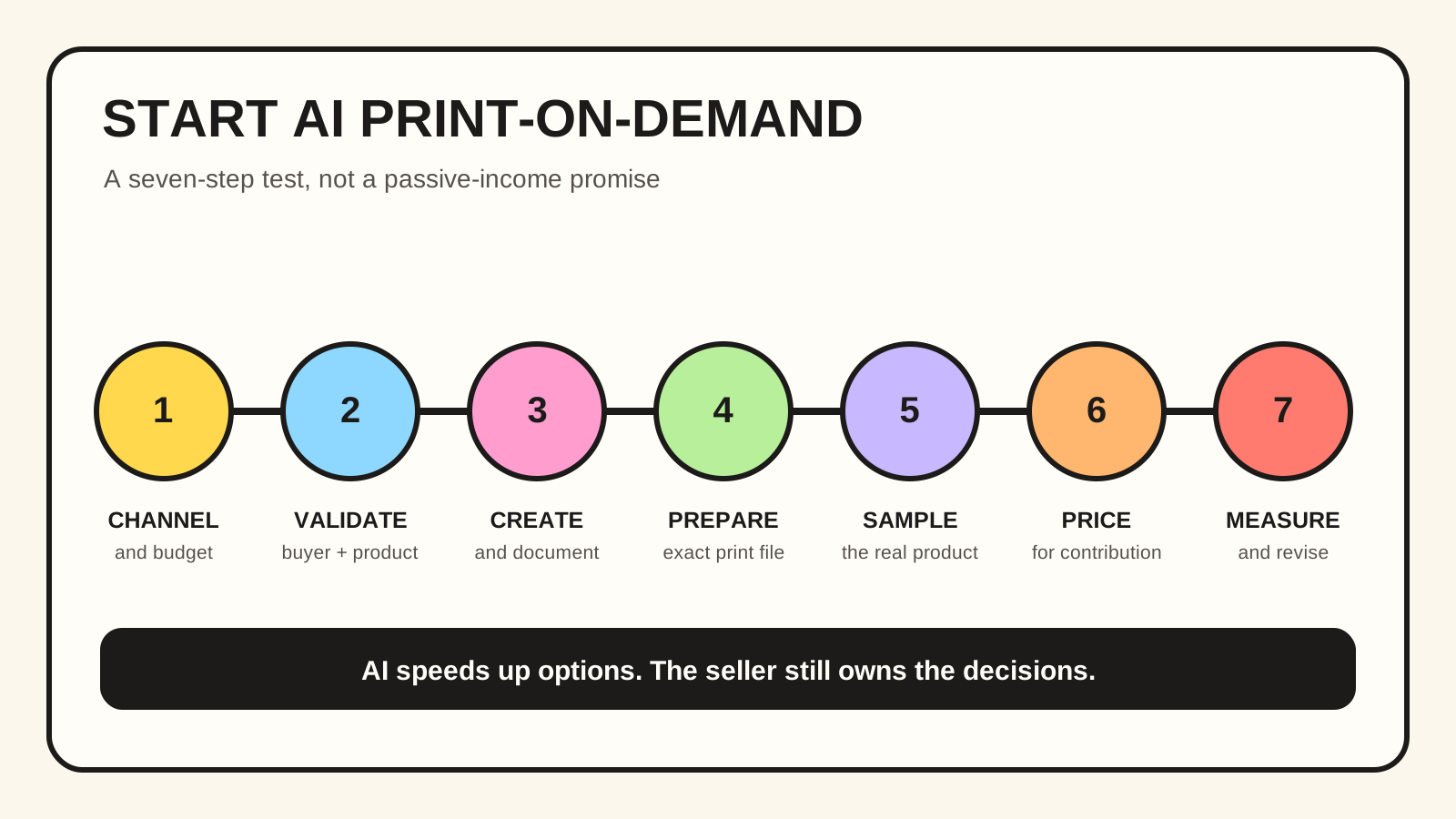
To start a print-on-demand business with AI, choose one buyer and one sales channel, validate a product idea, create original artwork, prepare it to the printer's exact template, order a sample, calculate contribution margin, and publish a small test. AI speeds up ideation and editing. It does not supply demand, legal clearance, print quality, or customers.
This guide is for a first-time seller who wants a lean, defensible launch rather than a promise of passive income. The broader print-on-demand business guide covers the basic fulfilment model; this page focuses on what changes when AI is part of the design process.
Seven-step launch plan
- Pick one sales channel and set a test budget.
- Define a buyer and validate a product idea.
- Generate, edit, and document original artwork.
- Prepare the file for one exact product.
- Choose a fulfilment partner and order a sample.
- Price from contribution margin, not a markup guess.
- Publish, measure the funnel, and revise.
What AI should and should not do in a POD business
AI is useful for exploring visual directions, making prompt variations, removing backgrounds, drafting listing copy, and producing rough mockup concepts. The speed is real. The tempting mistake is to turn that speed into a pile of unreviewed listings.
Keep the human decisions with the seller:
- which buyer problem or identity is worth serving
- whether the concept is original and safe to sell
- which generated details need correction
- whether the file meets the printer's requirements
- whether the sample is good enough for a paying customer
- whether the unit economics justify another test
A generation is not automatically a design, and a design is not automatically a product. That gap is where most of the actual work sits.
Step 1: Choose one channel and write a real startup budget
Start with a single route to market. A marketplace such as Etsy has existing shopper demand but charges seller fees and sets marketplace rules. An owned store gives you more control, but you must bring the traffic. Trying both at once makes it harder to tell whether the product, the listing, or the channel caused a weak result.
For an Etsy test, use Etsy's current fee pages rather than a figure copied from an old blog. As of this review, Etsy lists a $0.20 USD listing fee and a 6.5% transaction fee. Payment processing varies by country, and Etsy may show a one-time shop setup fee during onboarding.
Write down the cash you are willing to risk before opening accounts:
| Cost | When it occurs | Your live amount |
|---|---|---|
| AI or design tool | Subscription or usage | ____ |
| Marketplace setup and listings | Before or during launch | ____ |
| Product samples and shipping | Before promotion | ____ |
| Domain or storefront | Monthly or annual | ____ |
| Advertising | Optional test spend | ____ |
| Replacement reserve | When an order goes wrong | ____ |
Calling POD “free” hides the sample, fee, and cash-flow problem. A fulfilment partner may charge your card before a marketplace payout reaches your bank.
Step 2: Validate a buyer and product, not a broad niche
“Dog lovers” is an audience category, not a product brief. A workable brief names the buyer, the moment, the product, and the reason to choose this design. For example: an original group shirt for first-time participants in a specific local dog-walking event.
Use evidence from the channel where you plan to sell:
- Search the phrase a buyer would use, then note the products and visual formats that dominate the first results.
- Read recent reviews for what buyers praise or complain about: fit, print placement, gift timing, personalization, fabric, or packaging.
- Compare current price, delivery promise, image quality, and review recency across credible listings.
- Check whether interest is seasonal and whether you can publish early enough to sample and deliver.
- Write one reason your product is meaningfully different before generating art.
Do not treat autocomplete, a keyword-tool estimate, or a competitor's bestseller badge as proof of sales. They are clues. For more detail, use the merch demand validation framework and the current POD niche research guide.
Step 3: Create AI artwork and preserve the evidence
Generate several directions from the same brief, then edit the strongest one. Exact wording is safer as editable type than as pixels baked into an image. Look closely at hands, lettering, mirrored objects, tiny shapes, borders, and unwanted signatures. View the art at listing-thumbnail size as well as at 100%.
Keep a simple source record with each design:
- prompt and meaningful revisions
- model and provider
- generation date
- original output and edited master
- the provider terms that applied when you generated it
- fonts, stock elements, or references added later
- notes from trademark and marketplace-policy checks
AI output is not a shortcut around intellectual-property rules. Search for similar wording and marks in the countries where you sell; the USPTO trademark search is one starting point for the United States, not a complete legal clearance process. Avoid logos, protected characters, celebrity likenesses, and prompts that ask for a living artist's signature style.
Etsy currently places seller-prompted AI creations in “Designed by a Seller” and requires AI use to be disclosed. If a POD service prints the product, Etsy also requires sellers to disclose the production partner. Check the current rules for your own marketplace before publishing.
Step 4: Prepare one exact print file
There is no universal POD file specification. Requirements change by provider, product, print area, garment size, and print method. A transparent PNG may be right for isolated DTG artwork, while an all-over print uses the full template and does not want the same treatment.
For raster artwork:
required pixels = physical print size in inches × requested pixels per inch
A 14 × 16 inch print area at 300 pixels per inch requires 4200 × 4800 pixels. Changing a 1024-pixel image's metadata to “300 DPI” does not invent the missing detail.
Printify says product requirements vary and commonly recommends 300 DPI in its Product Creator. Printful asks for at least 150 DPI at actual print size, with higher recommendations for some print methods and detailed artwork. Use the live template, not a generic platform table.
MerchBanao can generate artwork, remove a background in the editor, place elements on a canvas, preview a garment, and export a 4200 × 4800 PNG. You still need to compare that file with the selected product template. The print-ready t-shirt guide explains the pixel checks in more detail.
Step 5: Compare fulfilment partners and order a sample
Choose the exact blank and printer, not merely the platform logo. A marketplace-style provider network can give you multiple printer choices; an integrated provider may offer a more consistent catalogue. Either way, compare live data for the product you will actually sell:
| Check | Why it changes the decision |
|---|---|
| Blank brand, material, and size chart | Drives fit, feel, and return risk |
| Print method and printable area | Changes artwork preparation |
| Production location and routing | Affects delivery time and consistency |
| Base cost by size and colour | Changes margin across variants |
| Shipping by destination and quantity | Changes checkout price and contribution |
| Branding and packing-slip options | Affects the customer experience |
| Reprint and refund policy | Determines who pays when production fails |
Order a sample to a normal delivery address. Inspect print placement, colour, fine lines, garment feel, packaging, tracking, and the real delivery time. Wash apparel according to its care instructions before scaling the listing. Provider mockups cannot reveal those things.
Step 6: Price from contribution margin
A markup on the blank is not a profit calculation. Model one order from the amount the customer pays through the amount left after variable costs.
Contribution per order =
item revenue + shipping charged
− fulfilment cost
− shipping paid to the provider
− marketplace and payment fees
− discounts
− advertising attributed to the order
− expected refunds and replacements
Keep taxes and fixed business expenses in the wider business model as required for your location. On Etsy, remember that the 6.5% transaction fee applies to the order total Etsy defines, including shipping and gift wrap charged to the buyer. Payment processing is separate and varies by country.
The POD pricing guide includes a fuller worksheet. Use current provider and marketplace figures every time you change a blank, destination, selling price, or promotion.
Step 7: Publish a small test and diagnose the funnel
Launch a coherent group of products for one buyer rather than scattering unrelated AI images across several niches. Use accurate mockups, a clear first image, the exact product details, a size guide, realistic dispatch information, AI disclosure where required, and the named production partner.
Then read the funnel:
| Signal | Likely question to investigate |
|---|---|
| Few impressions | Does the listing match language buyers use? |
| Impressions but few clicks | Is the first image, title, or offer weak? |
| Clicks but no orders | Are price, trust, delivery, sizing, or product fit blocking the sale? |
| Orders but little contribution | Are fees, shipping, discounts, or replacements consuming the margin? |
| Returns or complaints | Did the sample, listing details, or provider fail to set the right expectation? |
Do not declare a design a winner because it received one sale, or a failure because it had a quiet week. Record the observation window, traffic source, price, and any listing changes. Change one major variable at a time so the next result teaches you something.
AI print-on-demand launch checklist
- One buyer, occasion, product, and sales channel selected
- Startup budget and fulfilment cash flow written down
- Demand evidence collected from the target marketplace
- Original files, prompts, model details, and licence notes saved
- Trademark and marketplace-policy checks completed
- AI and production-partner disclosures added where required
- Exact product template and pixel dimensions verified
- Sample ordered, inspected, and washed when relevant
- Contribution margin calculated from live costs
- Funnel metrics and review date recorded
Start with one test you can learn from
The sensible way to start a print-on-demand business with AI in 2026 is small and measurable. Use AI to explore more directions, then slow down for the decisions that affect a customer: originality, file preparation, product quality, delivery, price, and disclosure.
Create one artwork direction in the AI merch designer, prepare it for one exact blank, and keep the source record beside the exported file. That is a better foundation than publishing fifty designs you have never inspected.
Marketplace rules, fees, and product specifications reviewed July 25, 2026. Verify live terms before publishing.