Best-Selling Print-on-Demand Products for 2026
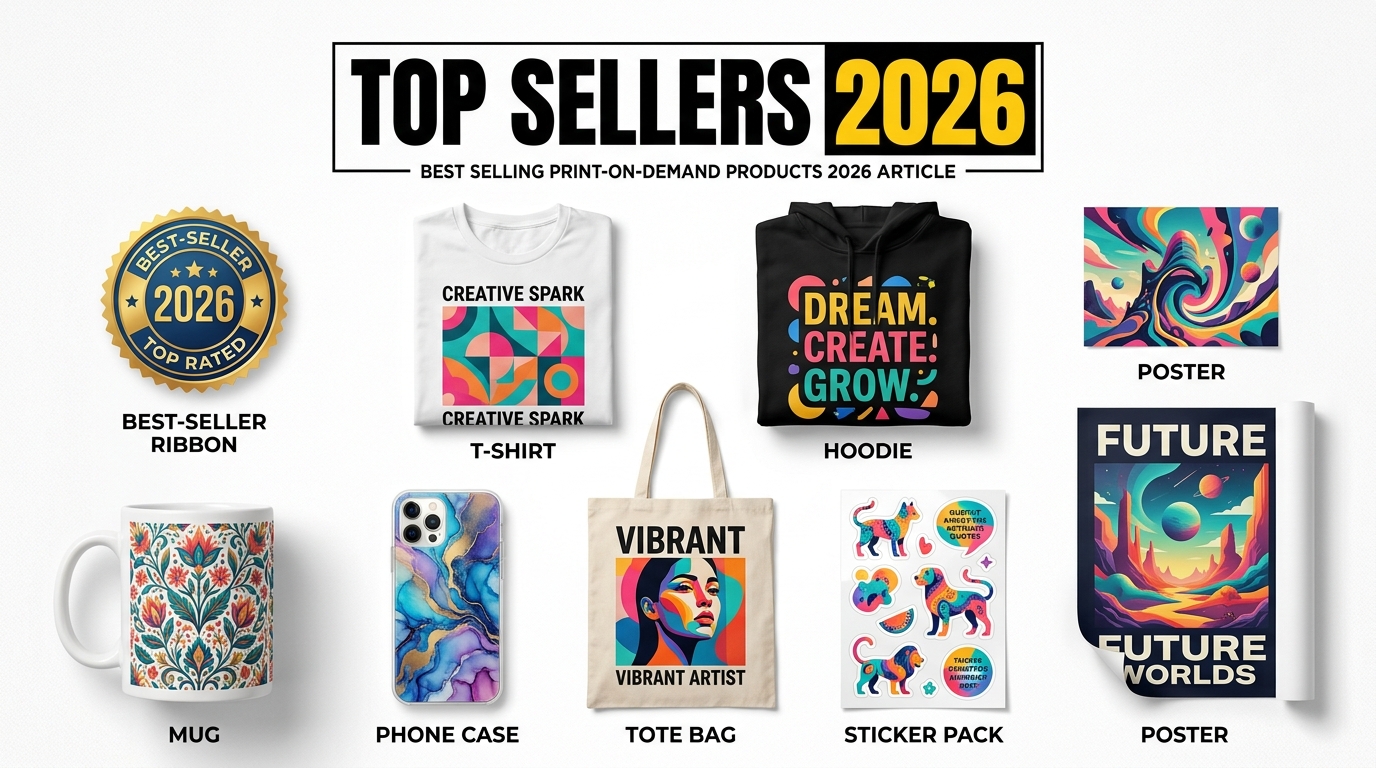
Custom t-shirts have the strongest claim to being the best-selling print-on-demand product in 2026. Printify calls the custom t-shirt its number-one POD seller, and Printful says its top-selling products sit in apparel categories such as t-shirts and hoodies. Mugs, wall art, phone cases, tote bags, stickers, and journals are useful extensions, but their order changes by provider, marketplace, region, season, and buyer.
There is no audited public table of unit sales across Printful, Printify, Etsy, Amazon, Redbubble, and every independent POD store. This guide does not pretend otherwise. It combines current provider performance claims with Etsy search data, then shows how to test the product-and-audience combinations in your own shop.
How this 2026 POD product list was built
Three kinds of evidence are kept separate:
- Provider performance: Printful says its 2026 list is curated from product performance across a range of niches. Printify publishes a current best-seller list and identifies t-shirts as its number-one product.
- Marketplace search movement: Etsy's Spring and Summer 2026 report uses U.S. signed-in search and sales activity from the three months ending February 10, 2026, compared with the same period a year earlier.
- MerchBanao interpretation: We map those signals to products a POD seller can actually fulfil. That translation is an editorial judgment, not marketplace sales data.
Provider lists naturally favour products in their own catalogues. Etsy search growth is directional and does not equal completed POD orders. Use both as a shortlist, then validate with current costs and your own listing results.
Best-selling POD products at a glance
| Product | Evidence in 2026 sources | Strong use case | Main risk |
|---|---|---|---|
| T-shirts | Printify's number-one product; Printful top apparel category | Identity, events, creator merch, evergreen niches | Heavy competition and sizing returns |
| Sweatshirts and hoodies | High in both provider lists | Higher-value apparel, teams, streetwear, cooler seasons | Higher fulfilment and shipping cost |
| Mugs | Included among Printify's core best sellers | Gifts, workplaces, family roles, personalization | Breakage, packaging, and seasonal concentration |
| Canvas and posters | Both providers include wall art; Etsy wall-art searches rose | Decor series, personalized maps, gallery sets | Ratios, colour matching, and shipping damage |
| Phone cases | Both providers include cases; Etsy polka-dot case searches surged | Pattern collections and visual micro-trends | Device-model inventory and trend turnover |
| Tote bags | Repeated across provider product lists | Bookish, local, event, and everyday-use designs | Fabric and print-area differences |
| Stickers | Printify includes stickers in its top ten | Low-price add-ons, bundles, creator communities | Low contribution per single item |
| Journals and notebooks | Printify includes both; Etsy reports analog-journal demand | Personalized gifts, planners, and themed stationery | Cover-only differentiation can feel generic |
Reviewed July 25, 2026. Product catalogues, prices, and marketplace demand change.
1. T-shirts: the safest first POD product
Printify's 2026 product guide identifies custom t-shirts as its number-one best seller. Printful's current guide says its top-selling POD products are in apparel, including t-shirts and hoodies. These are provider claims rather than an independent industry census, but they point in the same direction.
T-shirts work across many buying situations: identity, work, hobbies, events, community, fundraising, brand merchandise, and gifts. The blank is familiar, and buyers understand how to wear it. The hard part is not choosing "t-shirt." It is finding a specific buyer and reason to purchase.
Good product concepts connect all three:
- a defined buyer, such as a trail-running club rather than "outdoors"
- a use or occasion, such as a first group race
- an original visual system that can extend to more products
Generic slogans and copied trend graphics face the most competition. Check trademarks before publishing words on apparel.
2. Sweatshirts and hoodies: higher order value, higher exposure
Sweatshirts and hoodies appear near the top of both provider lists. They can carry the same chest graphic as a t-shirt, but the business math is different. The selling price may be higher; so are the blank, print, shipping, return, and replacement costs.
They are a sensible second product when a t-shirt concept already earns attention. The shared artwork reduces creative work, while garment weight and seasonal usefulness give buyers a reason to spend more. Test light and dark garment colours separately because the same graphic can read very differently.
Do not assume a higher retail price means a higher margin. Calculate the contribution dollars left after every variable cost.
3. Mugs
Printify includes mugs among its leading products, and Printful includes mugs in its broader 2026 best-seller catalogue. A mug is easy to understand as a gift and can carry a name, date, role, pet, team, or private joke. That makes personalization more defensible than a generic quote.
Mugs introduce operational details that shirts do not:
- left-handed and right-handed viewing positions
- wrap layout and safe areas
- box and breakage risk
- dishwasher and microwave claims that depend on the exact product
- shipping cost relative to the selling price
Use the fulfilment provider's live mug template. An 11-ounce mug from one supplier is not proof of the correct canvas for every other mug.
4. Wall art: the clearest Etsy search signal
Wall art has the most concrete marketplace evidence in this shortlist. Etsy's Spring and Summer 2026 Seller Trend Report reports that U.S. searches for "wall art decor" increased 110%, "gallery prints" increased 80%, and "abstract art" increased 38% in its stated comparison window.
Those numbers describe search movement on Etsy, not POD unit sales. Still, they support testing posters, framed prints, and canvas collections. A coordinated set often makes more sense than a single isolated image because buyers can build a gallery around a palette, place, memory, or theme.
Wall art needs more file planning than a shirt graphic. Decide which aspect ratios you will sell, make the composition work at each crop, and order a sample to judge dark tones, gradients, paper, and frame presentation.
5. Phone cases: strong visual trends, fast product churn
Phone cases appear in the current Printful and Printify lists. Etsy also reports an 835% increase in U.S. searches for "polka dot phone cases" in its 2026 comparison window. That is evidence for a specific style-and-product combination, not a promise that every phone-case design is rising.
Cases suit patterns, edge-to-edge compositions, botanical art, and personalized repeats. The operational downside is device coverage. Every phone generation adds templates, listing variants, and the risk of obsolete inventory pages. Start with the models your provider and audience actually support.
If a pattern works on cases, test it on totes, notebooks, or all-over-print accessories. One coherent pattern family is easier to merchandise than unrelated uploads.
6. Tote bags and stickers: useful complements
Tote bags and stickers occur repeatedly in current provider roundups. They are most useful as extensions of an existing audience rather than proof of a business by themselves.
A tote can turn a book-club, local-event, artist, school, or creator design into an everyday item. Check the real print area and fabric colour; product photography can hide texture and ink coverage differences.
Stickers are easy add-ons and bundles, but a low selling price can leave little contribution after fees and shipping. Packs built around one buyer or theme usually make more sense than unrelated singles. A sticker's cut line, border, transparency, and smallest details must be tested on the provider's template.
7. Journals and notebooks: a directional analog opportunity
Printify includes journals and notebooks in its current product list. Etsy's 2026 report adds a useful demand signal: searches for "traveler journal" doubled, "memory journals" rose 189%, and "journal charm" rose 395% in the stated U.S. comparison.
These Etsy queries span handmade and supplied products, not only POD notebooks. The practical interpretation is narrower: analog rituals and personalized keepsakes are worth testing. A cover with a stock-looking graphic is easy to ignore. A journal for a specific practice, trip, milestone, or recipient gives the buyer a clearer reason to choose it.
Check whether your POD product permits custom interiors. Many providers print only the cover, which limits how different the product can be.
Best selling is not the same as most profitable
A popular product can still lose money. Use live numbers from the exact provider, destination, and sales channel:
contribution per order = selling price − product cost − print cost − shipping subsidy − marketplace and payment fees − advertising − expected refunds
Compare both contribution dollars and contribution percentage. A sticker may show a high percentage but leave little cash per order. A hoodie may leave more cash but expose you to more shipping and return cost. Neither is "better" without the same audience, channel, and acquisition assumptions.
The POD pricing strategy guide explains the calculation and discount checks in more detail.
How to choose your first three POD products
- Choose one buyer. Write a one-sentence description that excludes most people.
- Choose one hero product. A t-shirt is the default unless your evidence points clearly to decor, stationery, or accessories.
- Add one close variant. Test a sweatshirt or hoodie with the same core artwork.
- Add one gift or add-on. Try a mug, tote, sticker pack, case, or journal that fits the same buyer.
- Calculate live contribution. Include shipping, marketplace fees, discounts, advertising, and refund allowance.
- Order samples. Check the blank, print, placement, packaging, and delivery experience.
- Publish a small test. Compare impressions, clicks, saves, add-to-carts, conversion, refunds, and contribution.
The merch demand-validation workflow gives a repeatable way to collect those signals before expanding.
Prepare artwork for the product, not a generic DPI target
There is no universal POD file specification. A shirt, mug, case, poster, sticker, and embroidered hat can require different dimensions, colour handling, bleed, transparency, and safe areas. Even two products in the same category can use different templates.
For raster art:
required pixels = physical print dimensions × requested pixels per inch
Changing the DPI metadata of a small image does not create detail. Open the current provider template first, build to its pixel dimensions, inspect at 100% zoom, and place the final file in the product preview. MerchBanao exports a 4200 × 4800 pixel PNG for common apparel artwork; resize or recompose it when the selected product uses a different template.
What to sell first
For a new general POD shop, start with one t-shirt, one sweatshirt or hoodie, and one complementary gift or add-on for the same buyer. For an art-led shop, test a poster or canvas series first. For a pattern-led shop, cases, totes, and notebooks may be the more natural hero products.
The product is only half the offer. Buyer, occasion, artwork, blank quality, price, listing, and delivery all affect whether it sells. Use 2026 product lists to narrow the field, then let your own store data decide what earns the next design.